
The conservation and restoration of industrial heritage is often undertaken by volunteers, frequently from a wide variety of disciplines and this project was led by those with a real appreciation for conservation principles and the authenticity and integrity of cultural heritage.
The purpose of this conservation engineering project was to change the wing on the Hawker Siddeley Hawk Mk 50; G-HAWK/ZA101, replacing the one which was on the aircraft in 2023 and which was not original. The aircraft had been in the Academy for Skills and Knowledge in Salmesbury where it had been mated with a Hawk Mk 53 wing with which it had never flown and had no history. This combination had been moved to Brooklands in 2019, assembled by a group of volunteers who had a background in Hawker Siddeley aviation and the aircraft had been on display since then.
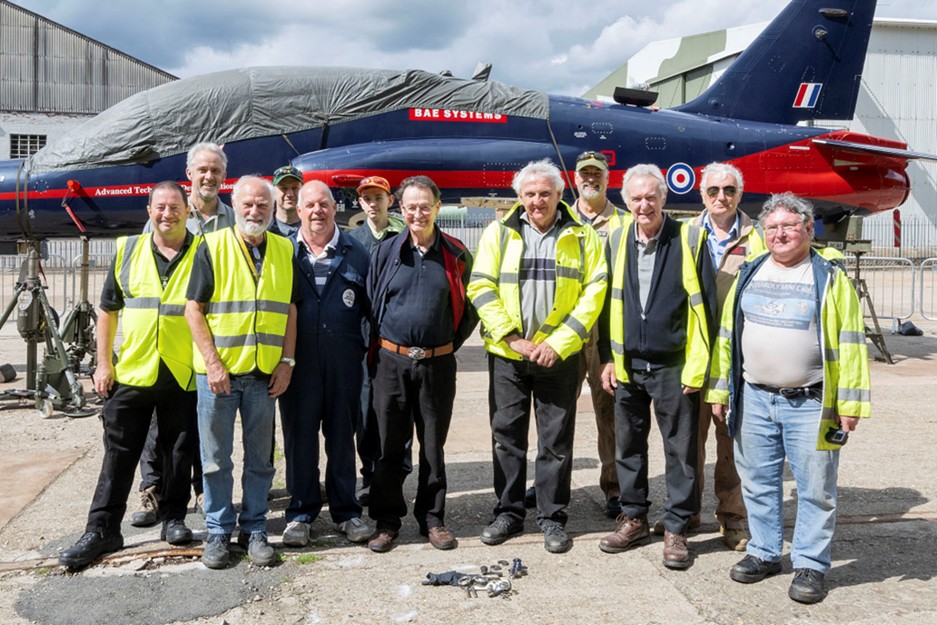
Team photo
The long-term plan in the Museum had been to restore the aircraft to the last configuration in which it flew, using the original wing with which the aircraft had completed all its flying, therefore restoring the provenance and authenticity of the exhibit. It was imperative to re-unite the wing and fuselage even though many people asked why it was necessary to expend a lot of energy on replacing one wing with another which looked almost the same. However, the wing change imparted authenticity by returning the aircraft to being complete as original and also for its display and interpretation.
This Hawk is the only Mk 50. It was line build number 312008 and the eighth to fly. Although never sold, it was retained by Hawker Siddeley/British Aerospace as a demonstrator and flight test aircraft with an instrumentation system which had the recorder in place of the rear seat when required. It was very similar to the T Mk 1s of the Red Arrows. The aircraft was put on the civil register as G-HAWK in which guise it flew demonstrations and sales tours all over the world. It acquired its military registration of ZA101 for weapons trials which the Civil Aviation Authority did not feel competent to regulate. It was used for many weapons clearance trials for export Hawks and flew with this dual registration for many years. (Incidentally, the Harrier T Mk 52, currently on display at Brooklands Museum, also carried a dual registration of G-VTOL/ZA250 for the same reason.)
G-HAWK went through many changes during its working life from May 1976 to February 2001, always with the same wing, which acquired a Mk 60 series leading edge, many different wing dressings and, eventually, the first example of wing tip stations for missiles. The fuselage was given the first aerodynamic representation of the Mk 100 series long nose. The aeroplane, with this wing, last flew in the Mk 100 series configuration with the long nose and the seven station wing (centreline hard point, four pylons and wing tip stations).
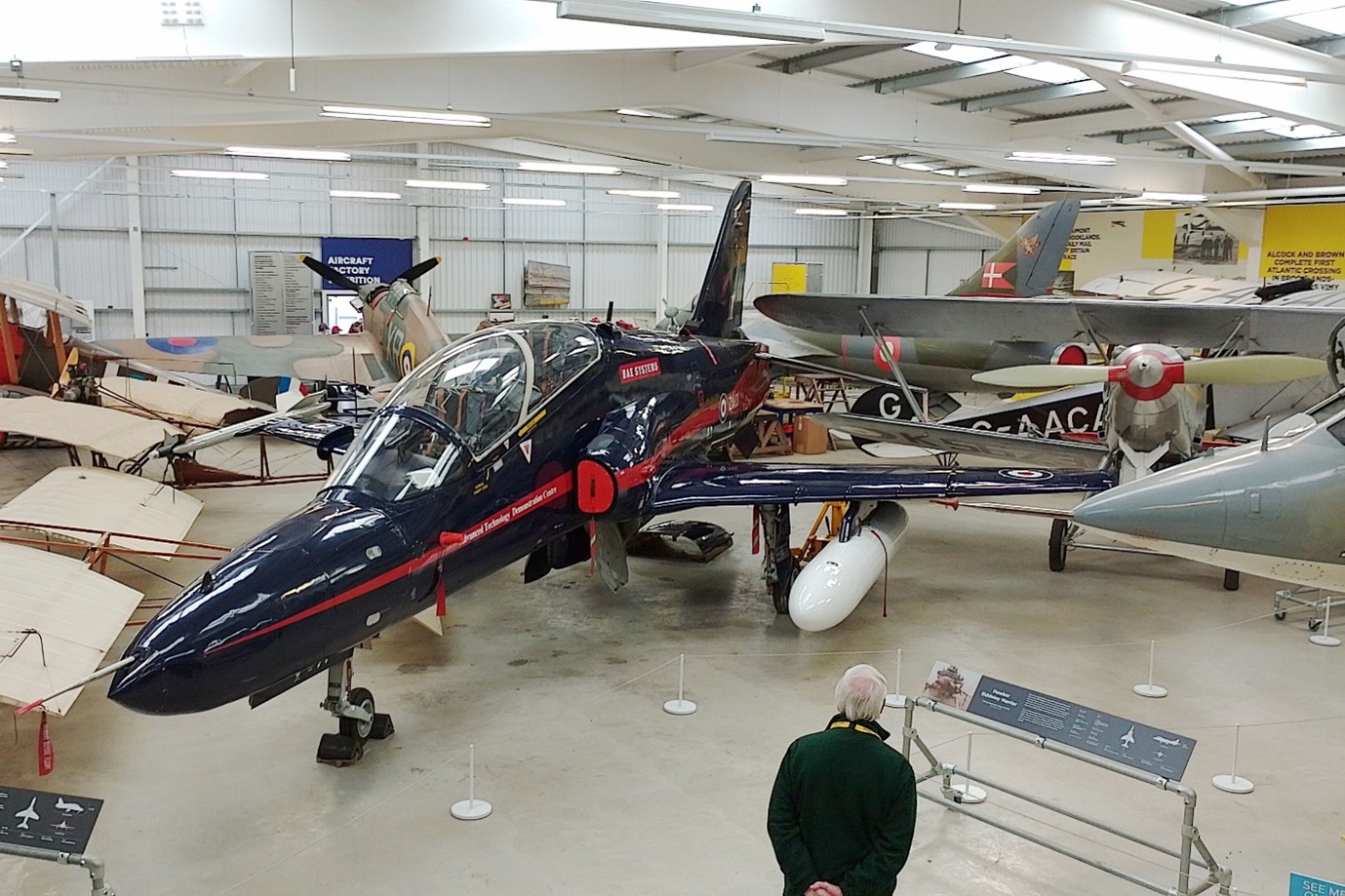
G-HAWK/ZA101
The original wing, with all this history, became available in 2021 and was transported to Brooklands where it stood outside the ‘Acoustics Building’ on its transport stand. It came with a false leading edge which had facilities for bolting on a set of slats and was painted in Indian colours. It never flew in this configuration, so the first task was to remove the plastic leading edge and sand all the filler off the original leading edge which was still underneath. When the weather became warm enough in the early summer of 2023 the wing was dressed in its last flying configuration of two fences, six mini-fences and thirty vortex generators. These were glued on with fuel tank sealant, as is done on all Hawks, which required a temperature above 15 degrees C to cure, hence the need to wait for warm weather. It then went off-site to R.A.F. Cosford Museum to be painted the same colour as the fuselage. To facilitate that, the ailerons and flaps were removed.
Changing a wing on a Hawk requires some ground support equipment (GSE), ie. aircraft jacks to lift it, trestles to support the fuselage and wing and lifting equipment (the wing weighs about a ton). It soon became clear that the wing change could not be done without the correct GSE which had to be sourced from across the UK aviation heritage industry, as the use of GSE bespoke to the aircraft was essential. Most aircraft would have been produced with GSE bespoke to their aerodynamic shape and design i.e. wing trestles. Sometimes however, it is possible that GSE such as jacks can be used across aircraft of similar date and design.
Whilst the original wing was away, the trestles, which were loaned by Chris Wilson of Jet Art, were transported from Yorkshire by Chris Hodson who also loaned his set of aircraft jacks which are usually at the Boscombe Down Aviation Collection (BDAC). We are very grateful to both of these individuals for supporting the project. The lifting equipment came in the form of an AEC Millitant Lorry or ‘Milly Tant’, as she was known, the National Rescue vehicle which lived at the museum. Milly had a gear selector problem which meant that she could not move easily, so the team had to plan to take the wings across to her to be lifted off and onto the transport stand and trestles.
The original wing was returned from R.A.F. Cosford Museum where it had been re-painted and a complete set of fasteners for the wing joint had also been obtained. After all this preparation, a group of the same volunteers, familiar with the aircraft, were ready to change the wing. The aircraft was taken out of the Flight Shed where it had been on display and had been positioned on the Finishing Straight with a canopy cover on to keep the rain out.
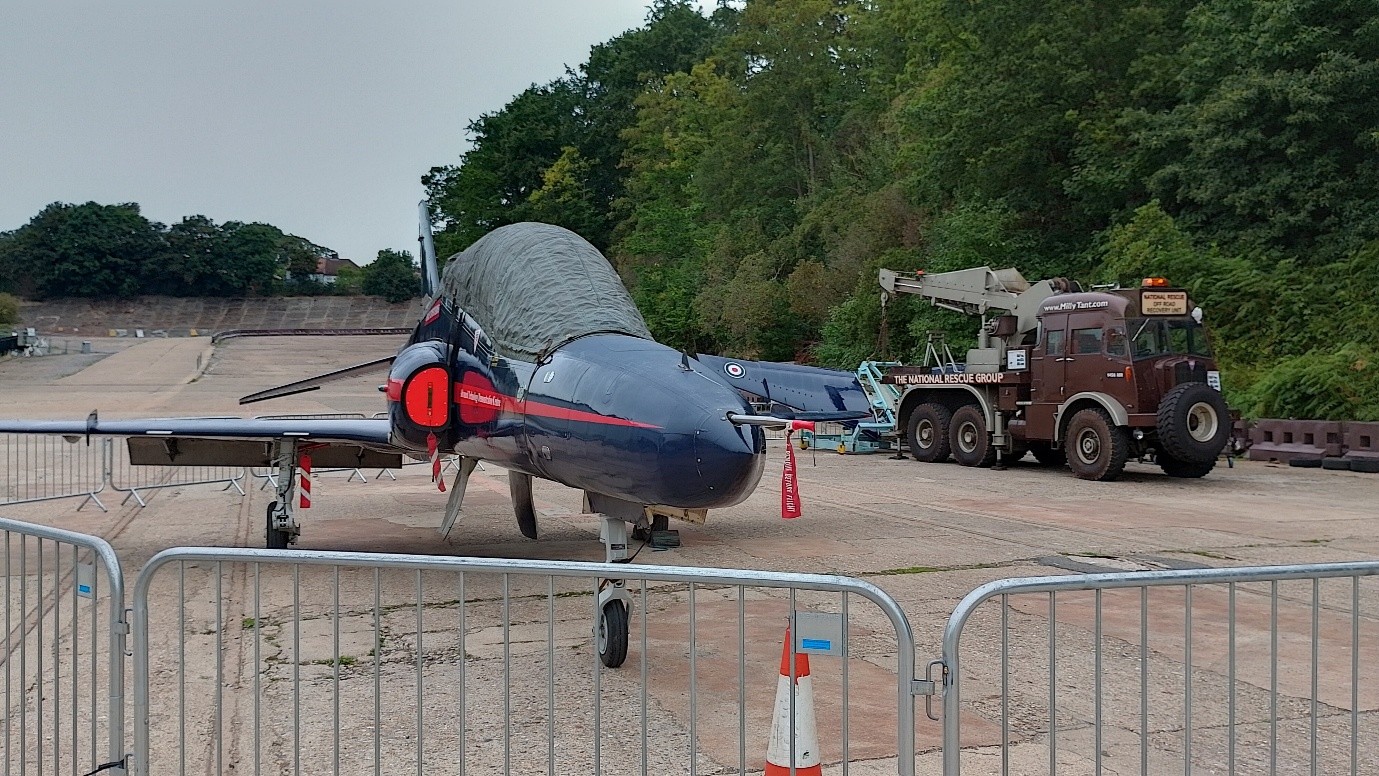
The aircraft out ready for the wing change with Milly and the original wing in the background
The team was ready for an early start at 0800 on August 26th 2023. The aircraft was jacked up on three jacks so that the trestles could be placed under the nose, tail and both wings and the jacks were then removed. The next task was to raise the main undercarriage so that when the wing currently on the aircraft was lowered there would be enough clearance to wheel it out from under the fuselage.
The 'down locks' stop the undercarriage from folding up when the aircraft lands. The pilot calls 'three greens' when the locks are indicating they are in position and safe to land (he has three green lights displayed). However, the undercarriage is operated by hydraulic pressure and to raise it requires pressure to release the 'down locks'. The hydraulics had not been used on this wing for years, so the only resort was to remove the jacks which raise and lower the undercarriage legs. The wheels then swung free and could be manually raised until the 'up locks' clicked into position. They are mechanical and require no hydraulic pressure.
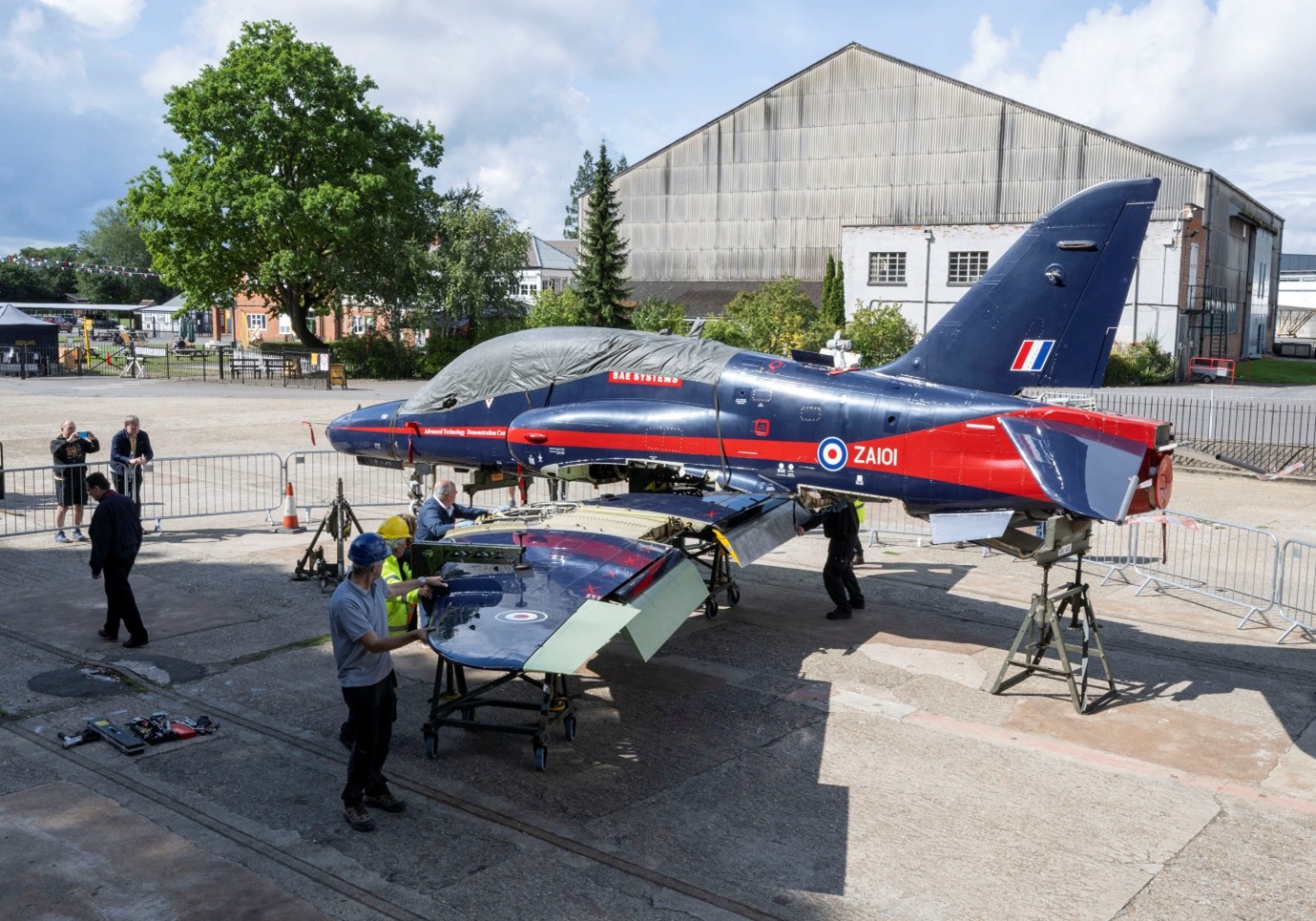
The later MK 53 wing being removed from the aircraft
Now the bolts attaching the wing to the fuselage were removed. The height of all the trestles could be adjusted so it was a simple procedure to very slowly and carefully lower the wing, which is a one-piece mainplane, until it could be wheeled out sideways from under the fuselage.
There was only one set of wing trestles available, so the next job was to lift the wing off the trestles, which is where Milly came into the story. The vehicle was able to lift and traverse the wing so that it could be lowered onto a set of tyres as supports instead of trestles, placed under the hard points of the wing.
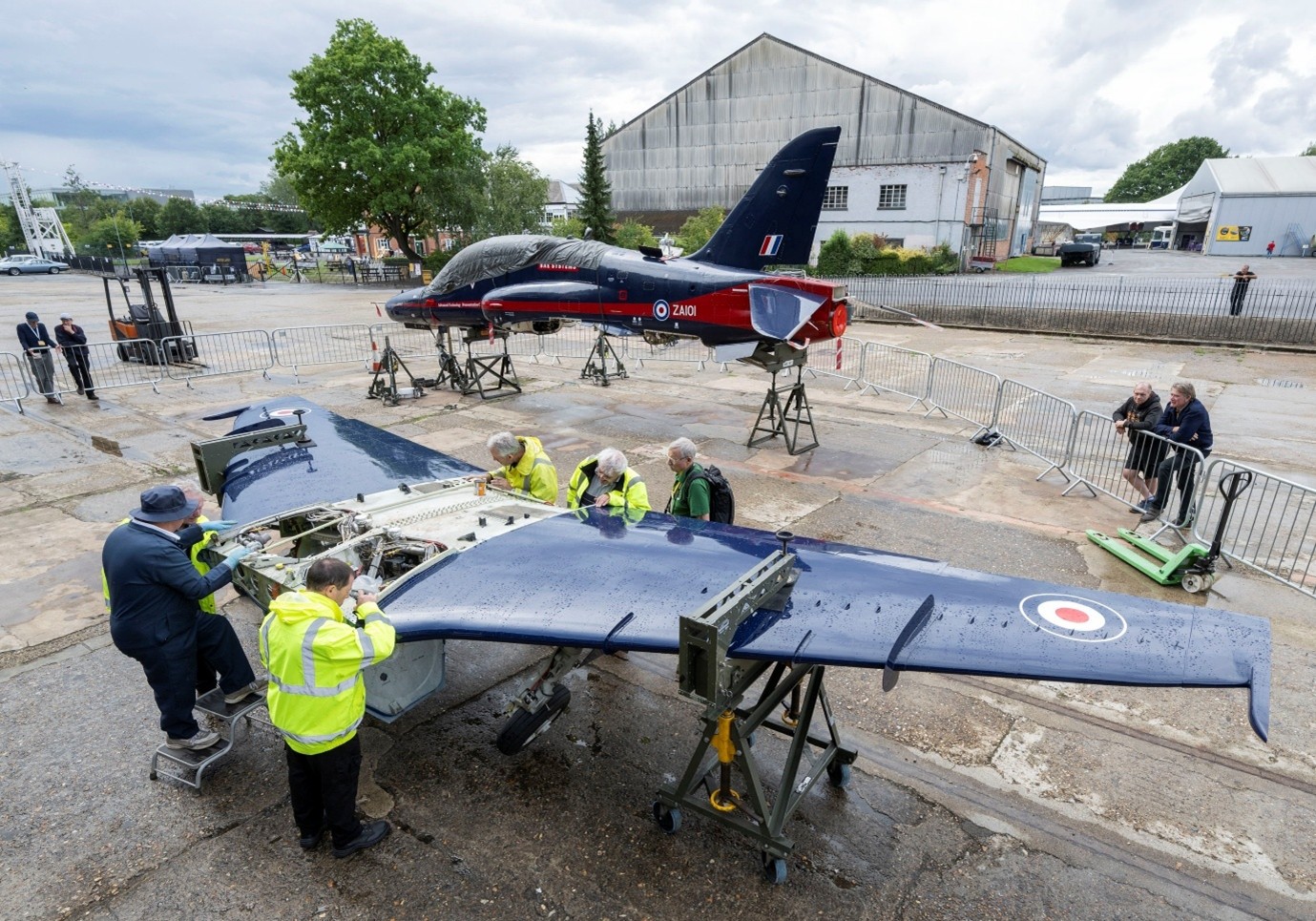
The original wing being prepared to be put back on, the obvious difference being the wing-tip pylons for the sidewinder missiles
Milly was then used to lift the original newly painted wing off its transport frame and onto the trestles. The 'up locks' on the original wing did not operate fully when the wing was prepared for transport for painting so the legs and doors were tied up with rope. This had to be removed from above while the wing was still on the trestles. After release, the undercarriage was held half up by a hydraulic lock in the system, which the team knew about, so there was enough clearance to move the wing to its position under the fuselage.
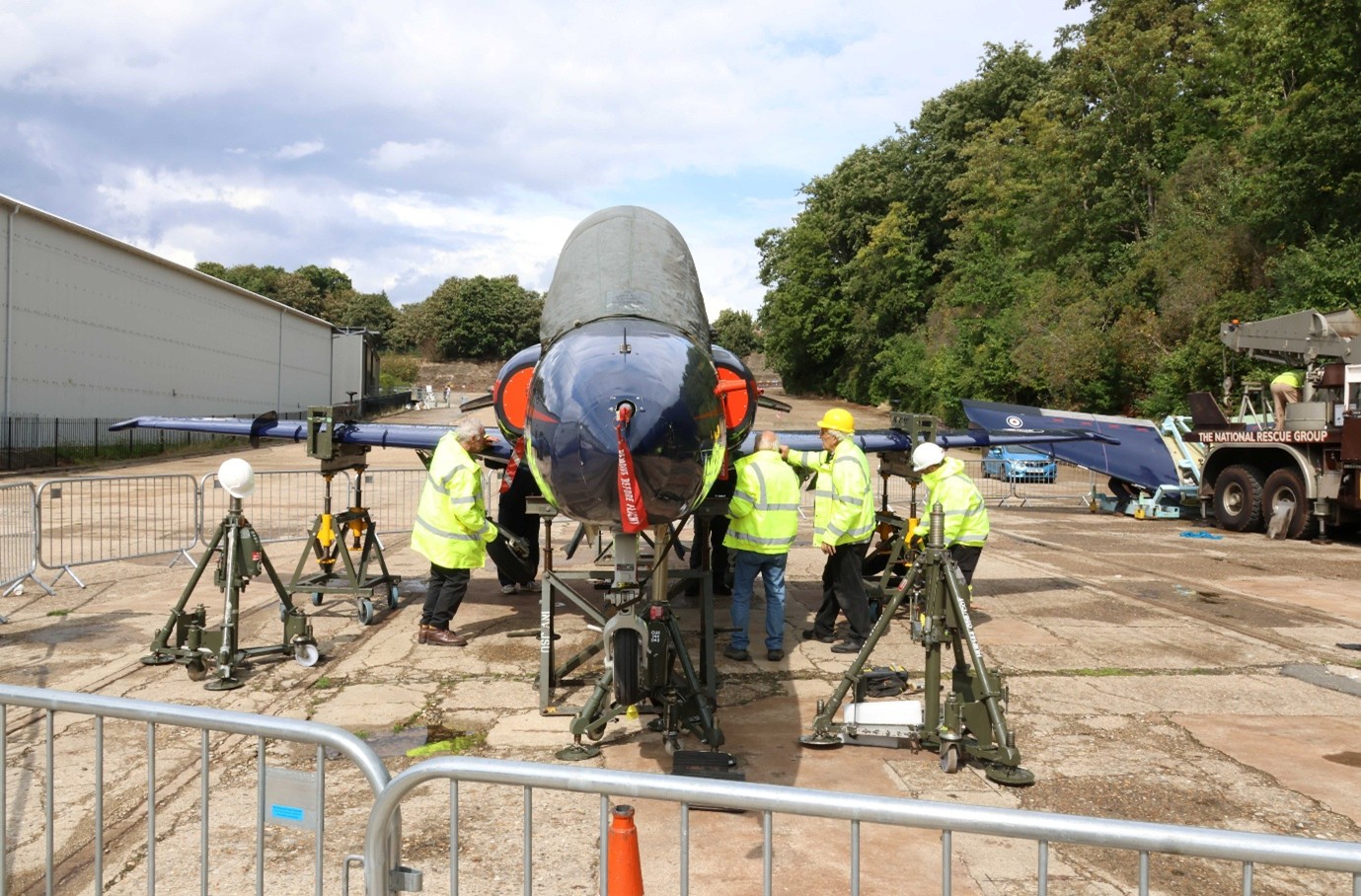
The original wing being fastened into position using borrowed ground support equipment (GSE)
With many eyes looking for potential fouls, the wing was slowly raised until the attachment points aligned. It was then a matter of connecting the front links, followed by the centre links and finally the rear mounts. All of these connections have spherical bearings and are close tolerance, so it took quite a while to connect everything. The team persevered and did a brilliant job aligning everything. Now it was time to lower the main undercarriage fully. The hydraulic pressure was slowly released by draining a small amount of fluid from the system and the 'down locks' operated. To be sure that there would be no failure, ground locks were then fitted to the main undercarriage jacks making it impossible for the legs to retract. The team had to work through two thunder storms while installing the wing but at least the cockpit remained dry due to the forethought of the person fitting the cockpit cover.
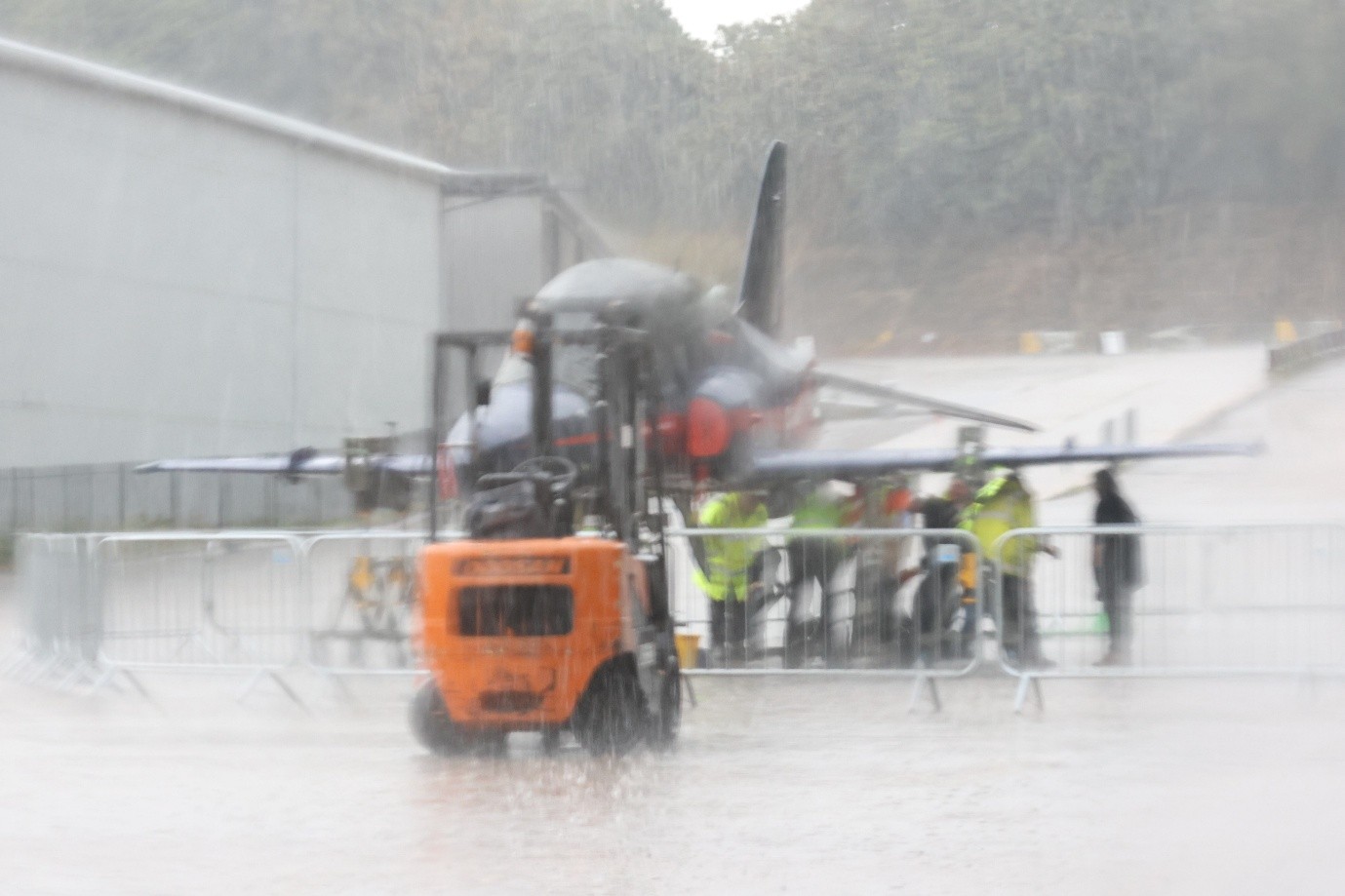
Allowing for the unexpected - in this case two lightening storms!
Milly had been repaired during the day and could now move so we had a very happy lifting team who lifted the wing that had been removed from the aircraft and put it onto the transport frame.
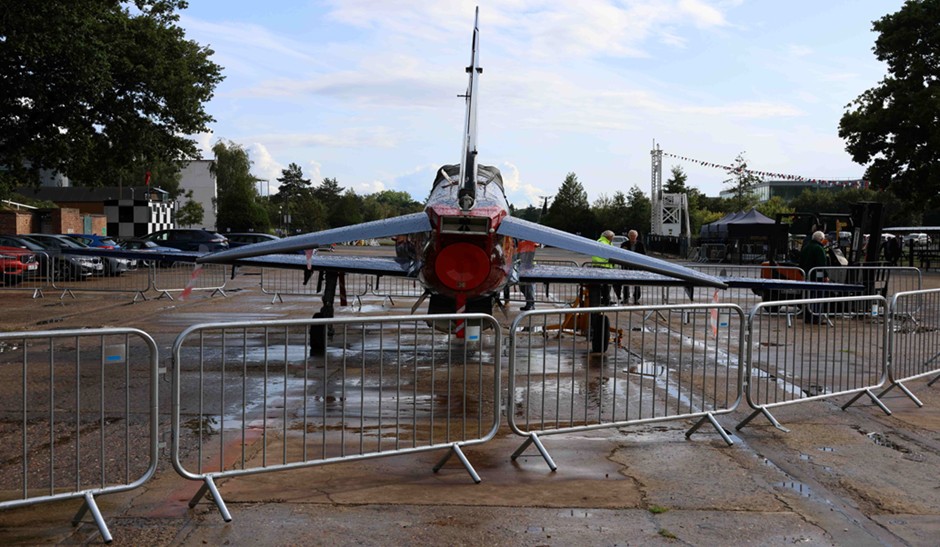
Good planning allowed contingency for fixing an unexpected collapse of the starboard oleo!
It only remained to lift the aircraft with three jacks again, remove the trestles and lower it to the ground. However, the starboard oleo (the undercarriage spring) collapsed. The spring is provided by high-pressure nitrogen which had leaked out on this side. The only answer was to jack up that side to take the weight off the oleo until it could be serviced. Servicing requires a Turner gauge which the Concorde volunteering team had had but was not available at tea time on Saturday so everything was tidied up for the day.
At Dunsfold a wing could be changed in four hours by a team of experienced operatives. The whole team was really pleased that the change had been completed successfully in about nine hours contending with thunder and lightning accompanied by very heavy rain showers.
The starboard oleo was successfully serviced after the Turner gauge was supplied by the Concorde team and the aircraft was repositioned back on display in the Flight Shed. Subsequent winter jobs included refitting the access panels, fin fairing, undercarriage doors, flaps, ailerons, pylons, drop tanks and gun pod with Sidewinders and launchers on the wing tips.
Conclusion
Community engagement across the aviation heritage sector was paramount to enable the correct GSE to be sourced, borrowed or loaned. The project would not have been possible without extensive collaboration to facilitate acquiring and transporting the equipment, often from hundreds of miles away and consequently involving a lot of good planning. The project highlighted the very real need to recognise that all aviation GSE should be preserved and is equally as important as the aircraft being preserved and for which it was made, often bespoke. There is now some concern across the heritage sector, that some museums which hold aviation heritage may not know what they have in their collections or what they are looking at, and, being unfamiliar with GSE, may be inclined to dispose of it. Further, the retention of the original GSE in operational condition as part of heritage aircraft maintenance plans should be seen as critical to the Emergency and Salvage Plans for all museums and heritage organisations.
This paper was submitted and accepted for presentation at the Icon 2024 Conference but unfortunately had to be withdrawn at short notice due to an unexpected house move. The conservation project has most recently been shared at a national meeting of Aviation Heritage UK (AHUK) and so, although some time has elapsed, it has been shared here, particularly for those involved with industrial heritage conservation and large objects, such as aircraft and working machinery.
Credits
Our thanks go to all the individuals who helped and those who took so many beautiful pictures and movies. The time lapse movie of the whole day is superb and can probably still be found on YouTube. This work also shows how well different organisations can co-operate.
Our thanks go to: Chris Wilson of Jet Art for the loan of essential GSE; Chris Hodson of Boscombe Down Aviation Collection (BDAC) for collecting and returning GSE and also for loaning GSE for the project; RAF Cosford Museum for repainting the wing; Mike Cowen of CMG (Vehicle Recovery & Movement Specialist) for transporting the wing to and from the respray; Andy Lambert for the use and operation of his AEC Millitant Lorry to do the wing lifts; BAeSystems Heritage; The Hawker Association; Brooklands Museum.
The images are credited to Geoff Lee and Mike Fantham, with thanks.
Amanda Sutherland, ACR
Former Head of Conservation & Collections Care, Brooklands Museum
Paul Rash, Hawker Volunteer
Former Chief Flight Test Engineer, Dunsfold
January 2026