
‘Conservation for Wellbeing’ has organised four series of workshops since 2019, for people with mental health challenges, using principles of culture therapy. We want people to feel less like patients and more like valued members of society. During the workshops, we discuss how objects are of value to us all and what they mean to us; emotionally, practically and symbolically.
As a creative response to the sessions, I have written the following story. I’m hoping we can find a way to use it during the workshops to help amplify the themes we are exploring. If anyone wants to get in touch, with a story of their own, please contact me - [email protected].
A glint of gold caught my eye as I switched on the hall light. The gloomy winter morning made the curtainless windows appear black against the white walls. I glanced sideways at the empty bowl. It could’ve been in a ceramics exhibition but instead it sat quietly in an alcove next to the kitchen.
I’d have liked to put it in a prominent place but don’t have the space. It has a wide, flat base, shallow sloping sides and rests firmly on the sideboard. It’s too large for salad and if I filled it with fruit you wouldn’t see the bold contours charting the outline of a naked woman.
The female form is painted with confident, almost insolent, brush strokes in dark gold lustre. She crouches low, feet pressed against the edge of the rim, just fitting inside. Her hands, fingers spread wide and pointy, hold ankles against her body; knees and arms contorted, encircling the space she inhabits. Her fish shaped eyes stare wide and contrast with a clear background glaze, broken only by neat golden spots which decoratively frame her like an outspread blanket.
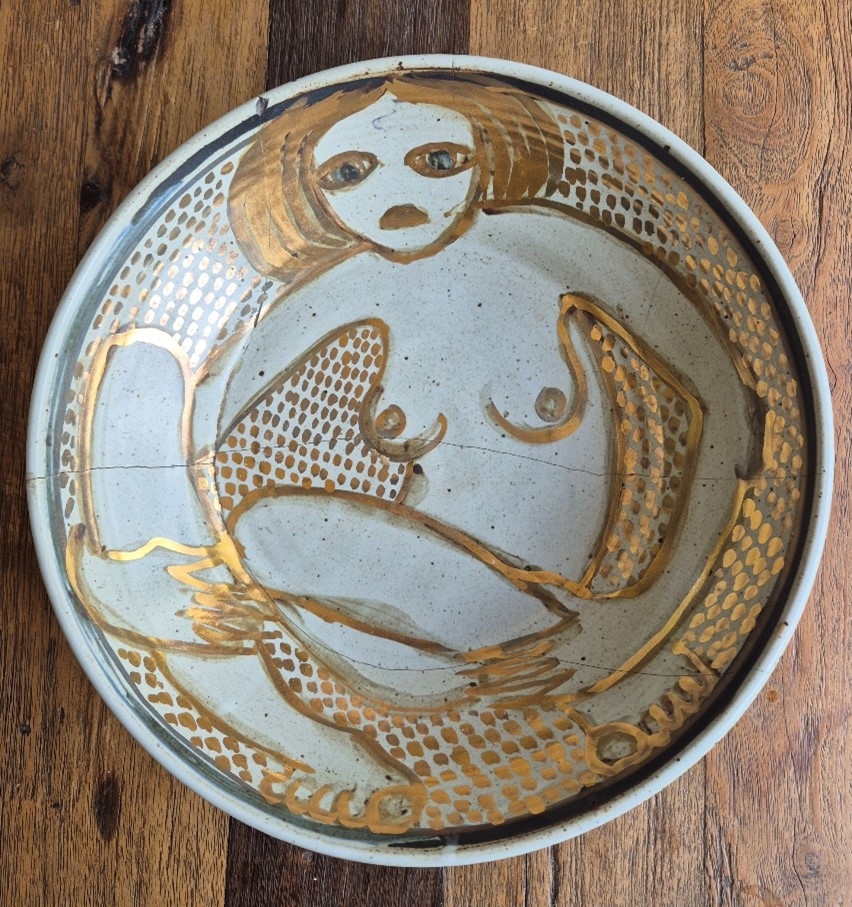
Bowl by John Dan
The bowl belonged to my mother, Meta, and she bought it from her ceramics teacher, John Dan in 1975. Long before that she was apprenticed to learn pottery in Amsterdam. She was twenty-five, an unusual age to start an apprenticeship but it was 1946 and everything was in disorder because of the war. She learnt to slap cold red clay onto wooden benches, over and over, to get the air out. It took months before she was allowed to throw a handful onto the wheel and start the process of pulling and tugging it into shape. After 5 years living in an occupied city, the simplicity of making plates and cups was precious.
“They were secretive, those old potters,” she said. “wouldn’t tell you anything, unless they had to. You had to creep up on them and watch what they were doing to work out the techniques. It took me years to even find out how to make the glazes.”
In 1954, mum came to live in Essex with my father. She brought with her a large wooden bed, 10 silver spoons and her potter’s wheel. By then she could throw cups, bowls, teapots, plates, anything really, with a quiet skill that I loved to watch when I was allowed into the pottery at the end of our house.
When I was 14, she started a 2-year course in Studio Pottery at the local technical college 8 miles away from our village. John Dan was the course leader. He was a short, stocky man who persistently wore dark blue cotton tunics and baggy trousers, dusty with clay handprints. I met him a couple of times as a teenager and was shocked when I first saw his pots. He didn’t seem like the sort of chap who would paint golden naked women.
There are 3 large cracks running across the bowl. They are clearly visible. One crosses her knee, tips under a breast before curving across her belly and left arm. The other long line follows the inner curve of the base, splits off into her hair and becomes a deeper chip at the top of the rim. The shortest one runs over her left hand, up the side and over her left foot.

Crack and chip running through hair
Sometimes I think, I should get those cracks fixed properly so they don’t show.
But it was my long dead mother who stuck the bowl together with araldite epoxy resin glue. You can see it on the underside of the pot. She didn’t do it well and there’s a lot of glue left around the crack but it’s her hands that mark it. As a conservator I know it’s the wrong way to carry out a repair because a mend should always be weaker than the original. Araldite glue is horribly strong and would probably take a strip of clay with it if anyone tried to take it apart.

Base of bowl, adhesive remnants visible. W in a fish = Wivenhoe Pottery
My parents didn’t have much money. Part of the war time generation, they hated to waste food and repaired even the cheapest broken belongings rather than buy new. It would never have occurred to my mother to ask a conservator to mend a damaged bowl. There would have been a half-used tube of glue in a kitchen drawer, along with other household clutter gathered in hidden corners of a house lived in for decades and, alarmed by the breakage, she would have felt compelled to fix it straight away. To bring the pieces back into something whole.
As I look at the bowl and sip my morning cup of tea, the cracks and brush strokes prompt thoughts of my mother’s anxiety and her shattered youth. How she spent the war years in an occupied city where life was upside down and full of secrets. Meta and her sisters learnt to survive in little bits of time.
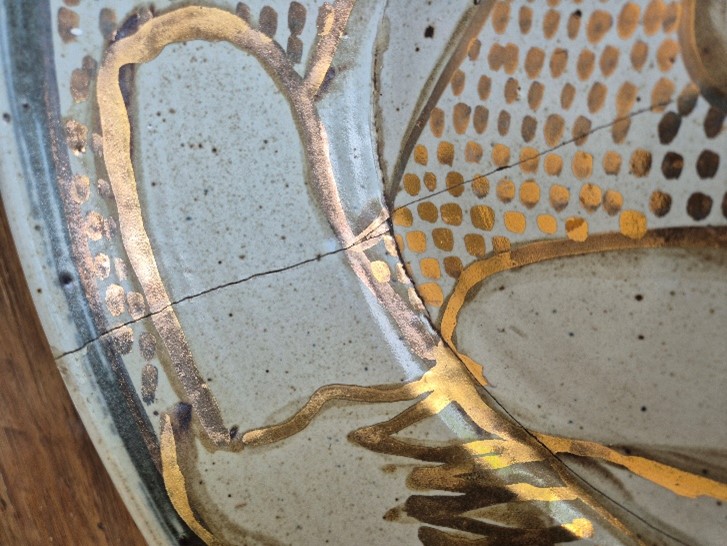
Crack running across legs
I think about how she reconstructed her life, moved to another country, raised a family and learnt to make pottery in a new way. The broken pieces of pottery, separate and lost on the floor would have transported her back into that war time of fracture, a homeland invaded, a life demolished. The mends are more than glue and clay, they are her restoration, a necessary act to hold life together.
By Helen Lindsay ACR