
Stuart Brockman reflects on the process of binding four large-scale memorial volumes listing thousands of service personnel who lost their lives while serving since the Second World War.
A Memorial in Vellum and Oak
The largest and potentially most complex project the bindery has ever undertaken began in the middle of 2004 and was completed 19 years later.
Representatives of the Armed Forces visited the bindery in July 2004 to discuss binding a calligraphic record of all that had very sadly lost their lives, whilst serving, since the second world war. This project, for the first time, was to include the Army Reserves.
It is a great honour and incredibly humbling to take on projects of this kind. Our efforts, throughout the process, seemed incredibly insignificant compared to the sacrifice given by the several thousand people listed.
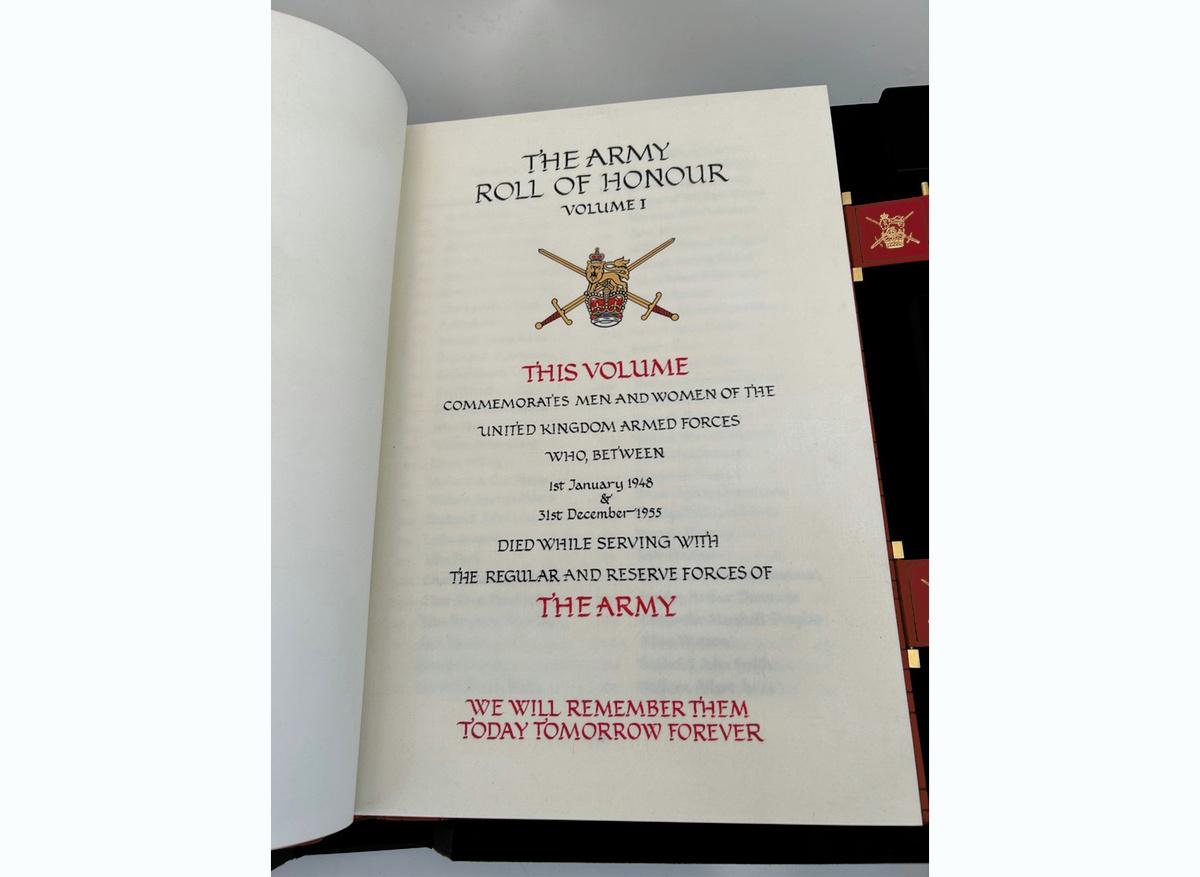
Calligraphic Title Page
The Commission
The Army representatives had, at this stage, painstakingly compiled a spreadsheet with all the names, ranks, and dates.
My father, James, drew up a specification for the project largely based on similar memorial books he had worked on in the past. In short, the books were to be calligraphically written on vellum, marbled endleaves, gilt edges, oak boards, double endbands, full leather with blind and gold tooling, silver gilt clasps. The vellum specified was to be approximately 0.3mm thick. The design for the books, which we still have and is dated November 2004, was a complex strapwork design with gold dots and the army crest in the centre of the front boards.
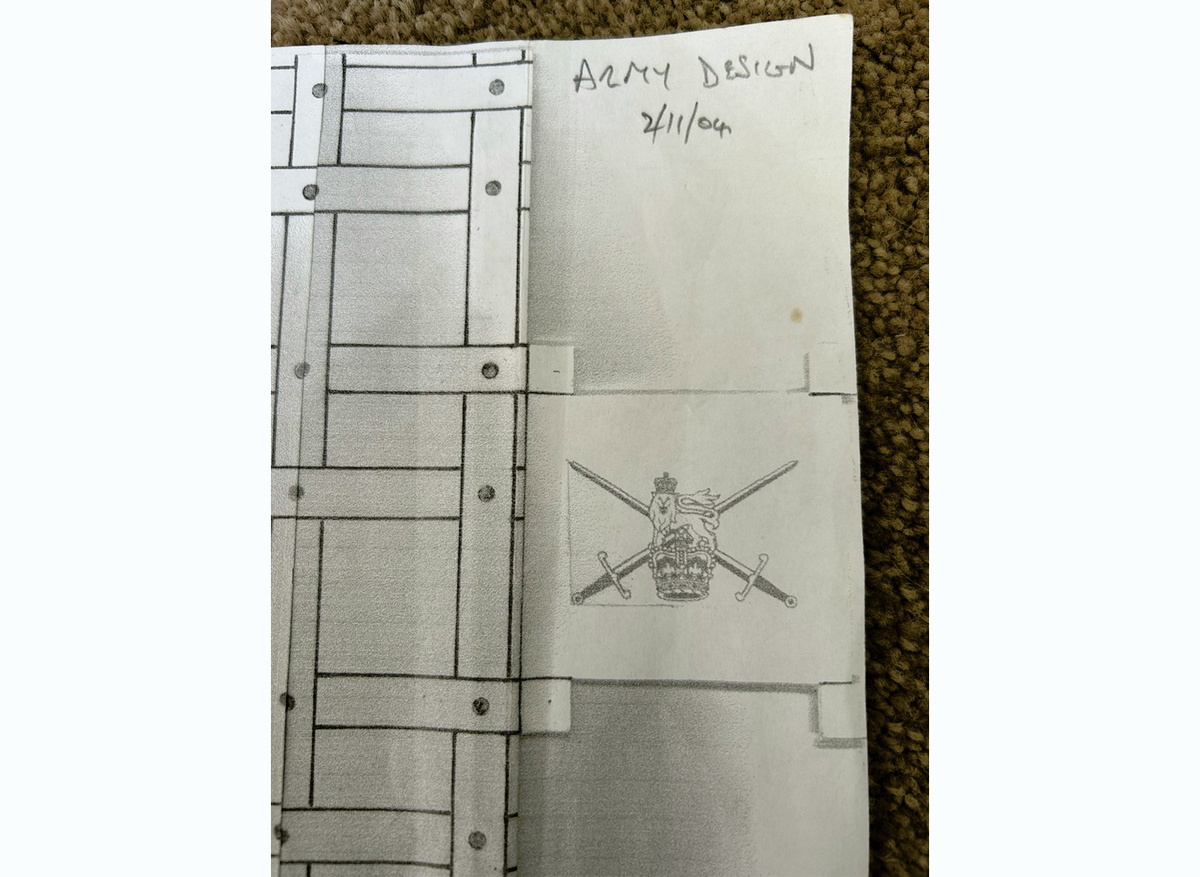
Close up of design showing the date!
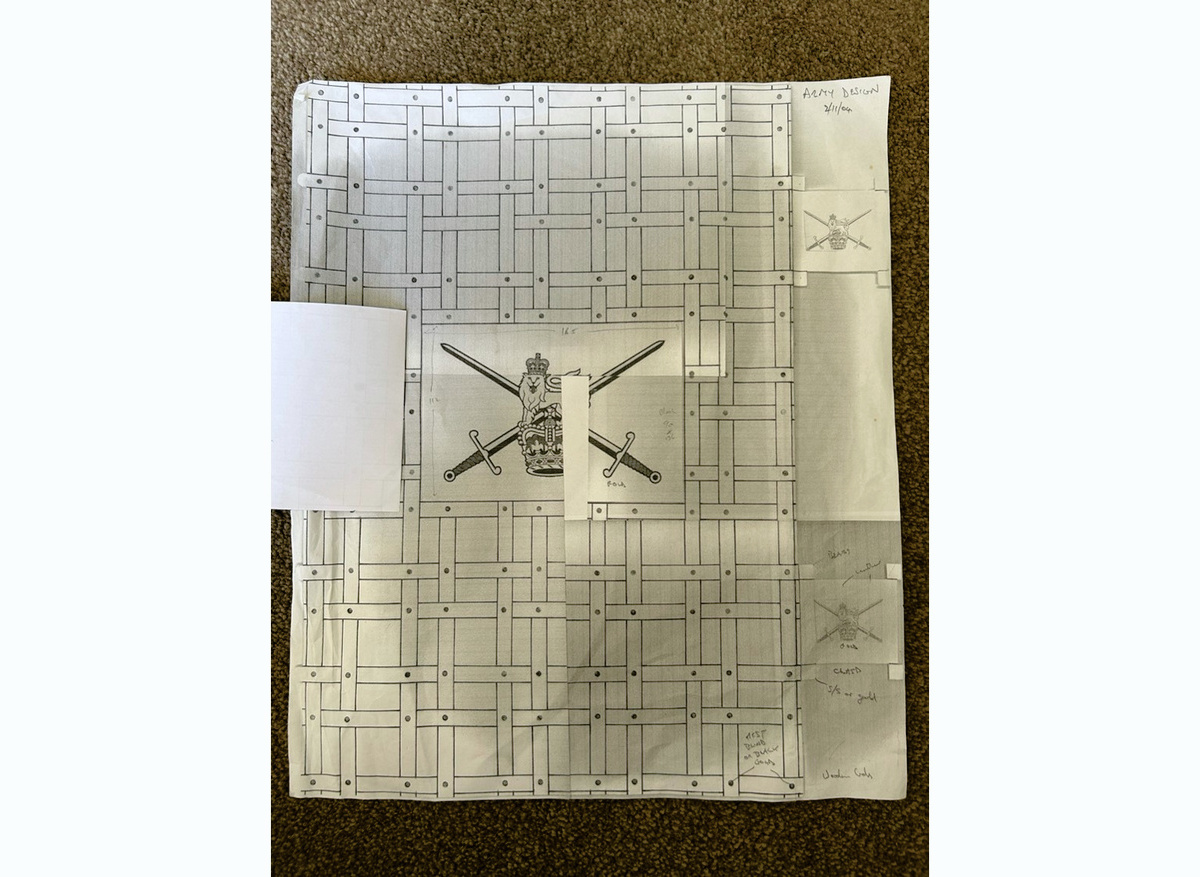
Photocopy of the design supplied for front boards
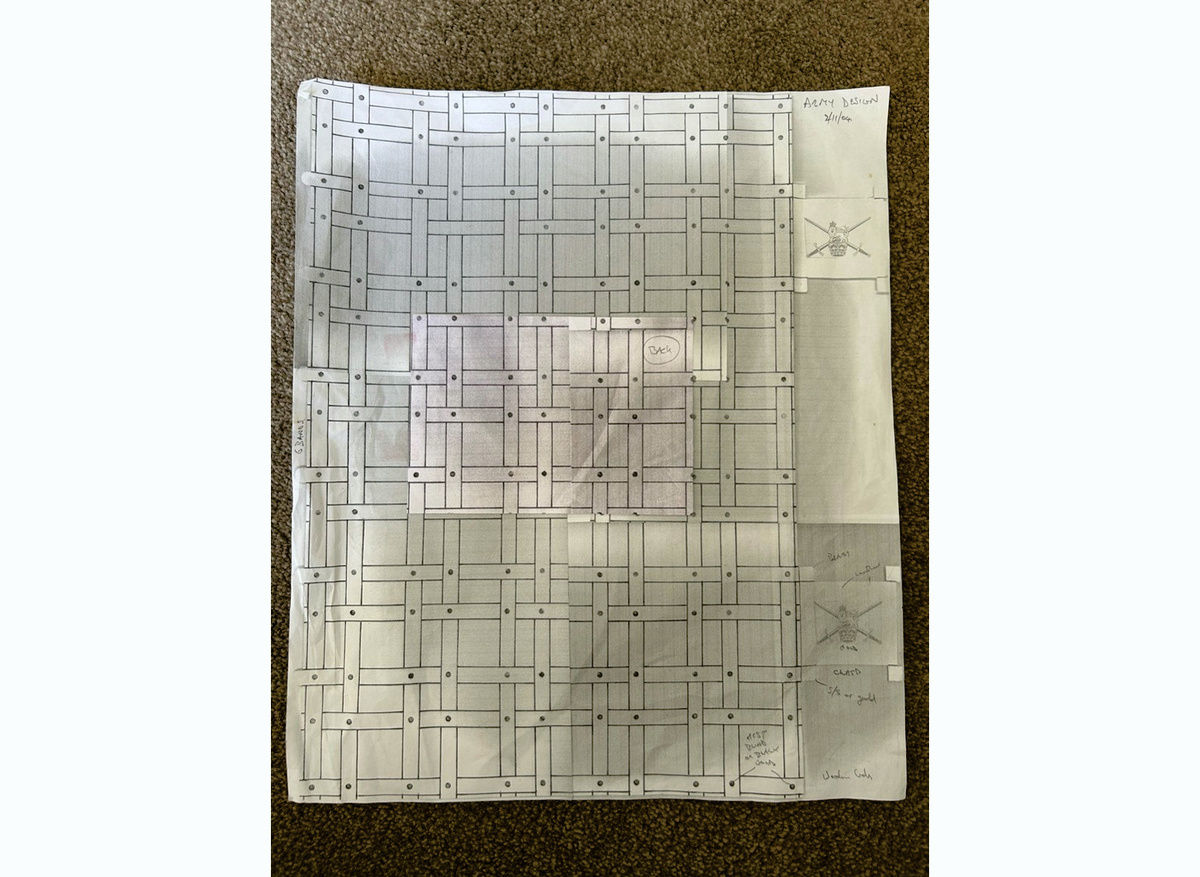
Photocopy of design supplied for rear boards
Gathering Materials
In early 2005 my father and I ordered four very large scarlet goatskins from Harmatan and spent the day at a timber mill near Coventry carefully selecting quarter sawn oak. The oak required needed to be over 12 inches wide – this, for English Quarter Sawn Oak is a tall order, but we found 2 very lovely planks in amongst the hundreds available.
We had all materials in stock, except the marbled paper, which we figured would be easy enough to source from Ann Muir (Louise wasn’t marbling that much in 2005!).
In the meantime, calligraphers in Scotland began the task of writing out the names.
In around 2018 having stored the leather in our cupboard and seasoned the oak on supports in the garage, we heard the calligraphers had finished! There had been one or two hic-ups along the way, the first calligrapher I believe had sadly died, the second retired, the third finished the enormous task.
The leaves were delivered to us. One rather worrying aspect of the leaves was the sheer weight, this was explained when we opened each packet of unfolded sheets to discover the vellum used was around 0.6 - 0.8mm thick! The leaves arrived at a time when we were incredibly busy and they sat in the cupboard for a few months. We decided to begin the binding in around June 2018. My father looked at the leaves first and, as he has a habit of doing, noticed an error with a date. On further inspection of all four volumes many more errors came to light. It was decided to send the leaves back to the calligrapher for correction before we started binding. We figured it would be much easier for them to work on flat sheets rather than a bound volume. In order to make the calligrapher’s task more straightforward, my father and mother, Georgina, painstakingly looked through all 4 volumes checking each entry for accuracy. A list was prepared for each book and sent with the volumes back to Scotland.
Binding Begins
In late spring 2023 the leaves were delivered again. We finally had to bind them!
First problem – folding the very thick vellum leaves. After much head scratching and a few trials, we had no option but to reduce the thickness of the vellum where the fold would be. Without thinning, the vellum cracked – the thickness generated too much compression on the inside and too much tension on the outside. Rather than thinning a small strip we decided to thin 15mm either side of the fold location, thinking this would help with the way the book functioned once bound.
The single most stressful week of my life then started – one volume at a time was taken and sanded in my outside workshop - this was to avoid vellum dust in the bindery. I used a specially made wooden sanding block with a 30mm flat area at the centre that then gradually curved upwards. It was hot – well over 20 degrees, I had a mask, steamed up glasses and sweat beading on my brow. In order to keep the manuscript as clean and dust free as possible I covered it with thin card at all times, leaving only the area to be sanded exposed at any one time. This was enormously important as the one time a very small bead of sweat dropped onto the text it began to bleed out – the ink used was water soluble! The bead of sweat was lifted with a piece of kitchen towel before any damage was done! The constant fear of detrimentally affecting another craftsperson’s many hours of work, combined with the sense of responsibility to the fallen and their families, was at the forefront of my very stressed mind.
During the trials I had worked out how many passes with a 120-grit sandpaper would remove 0.1mm of vellum – a surprisingly high number! So, for each vellum sheet I was constantly checking thickness with a micrometer and counting in my head the number of passes to achieve the required thickness – 0.3 to 0.4mm.
To soften the vellum a little further to help with folding and to remove any scratches from the sanding the vellum was very lightly rubbed with damp cotton wool. I say damp – it was virtually dry, to avoid distortion, and rather than water we used milk. The enzymes in milk, as seen when cleaning old vellum bindings, seems much more effective than water.
After a long lie down in a darkened room we were then into the normal binding processes.
With vellum leaves it is best to isolate them from any moisture added to the spine when glued up. To do this we usually add a very thin handmade paper loose guard to each gathering before sewing. As we had removed a reasonable thickness of vellum, in order to fold, in this instance we added a much thicker handmade paper loose guard to each section – approximately 0.2mm thick paper.
Unfortunately, the great marbler Ann Muir passed in 2008. We therefore called upon another for this project – Louise!
Endleaves were made up with a folio of vellum adhered to the marbled paper, leaving a tab of paper that would be put down onto the inside of the boards later before adding a topper of the same marbled paper.
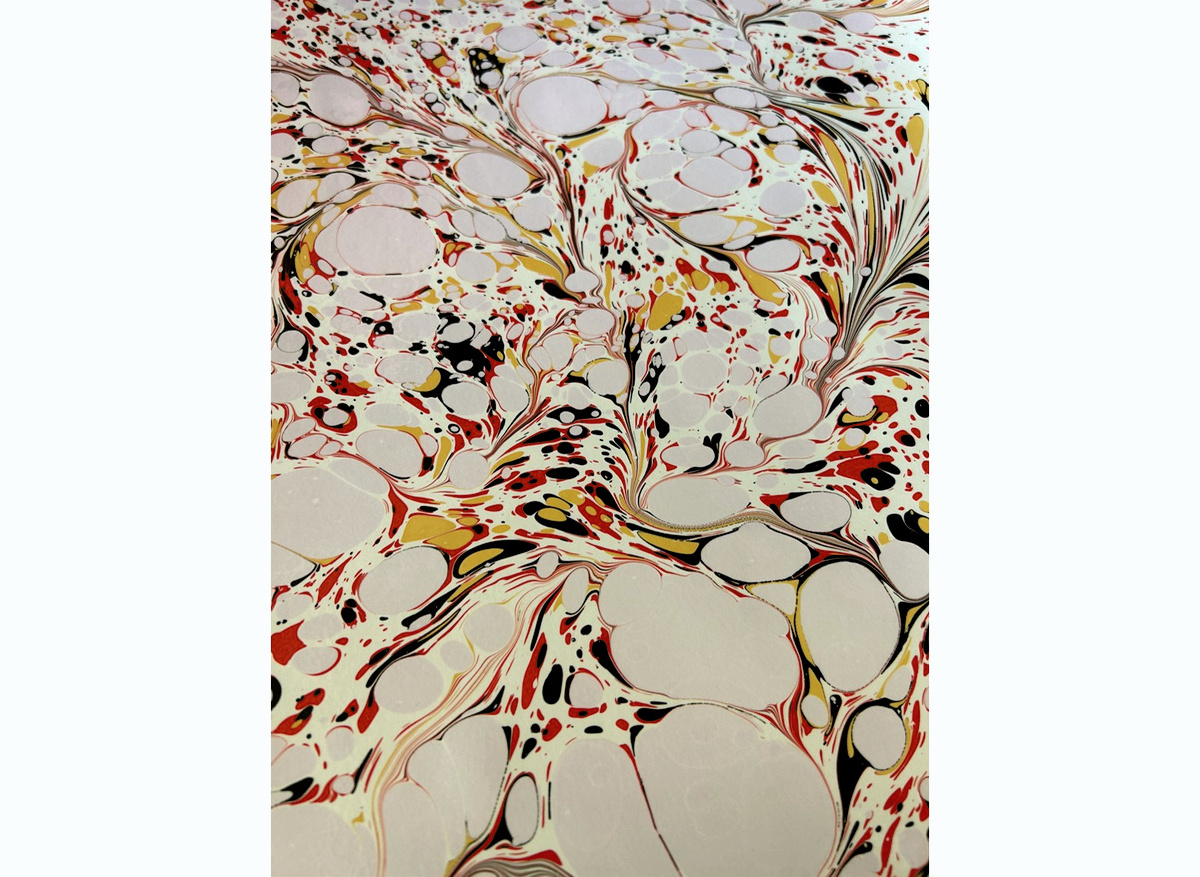
The marbled paper
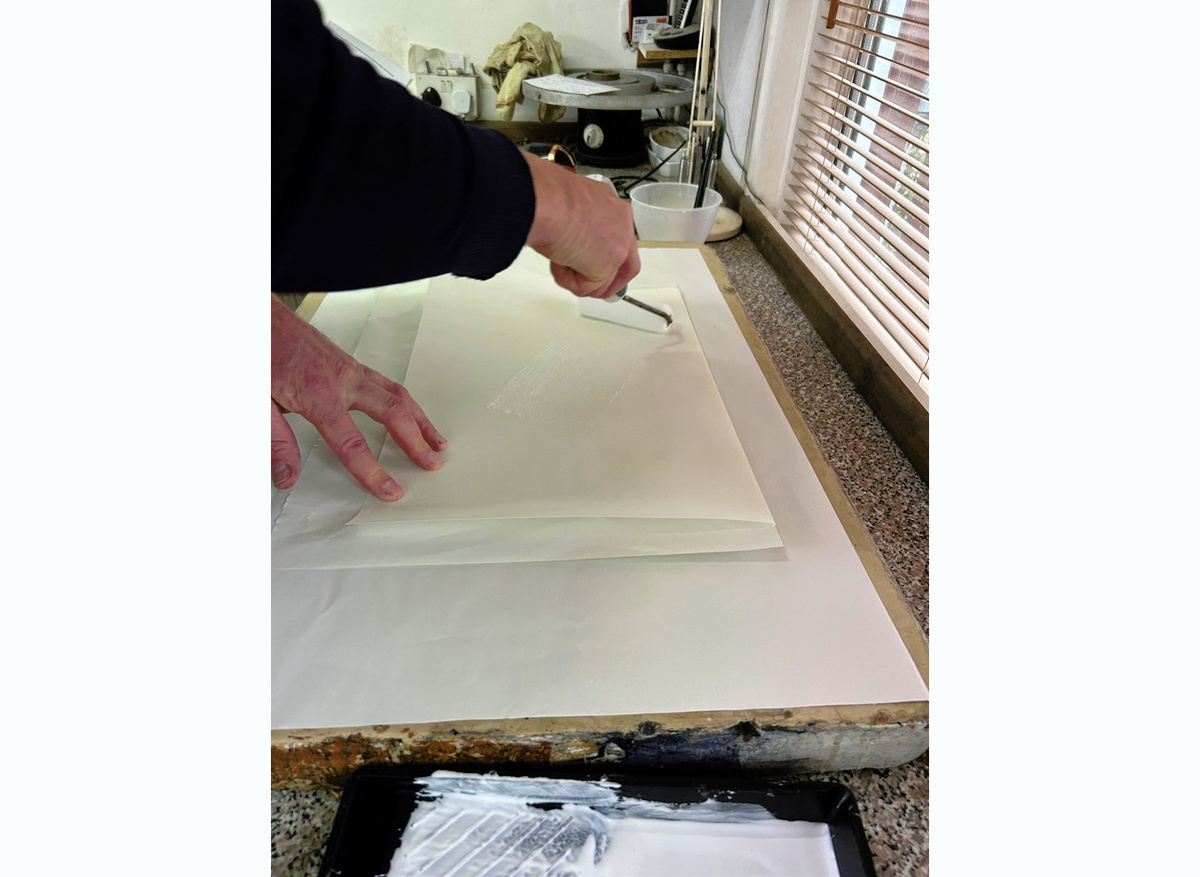
Gluing out the vellum with a roller
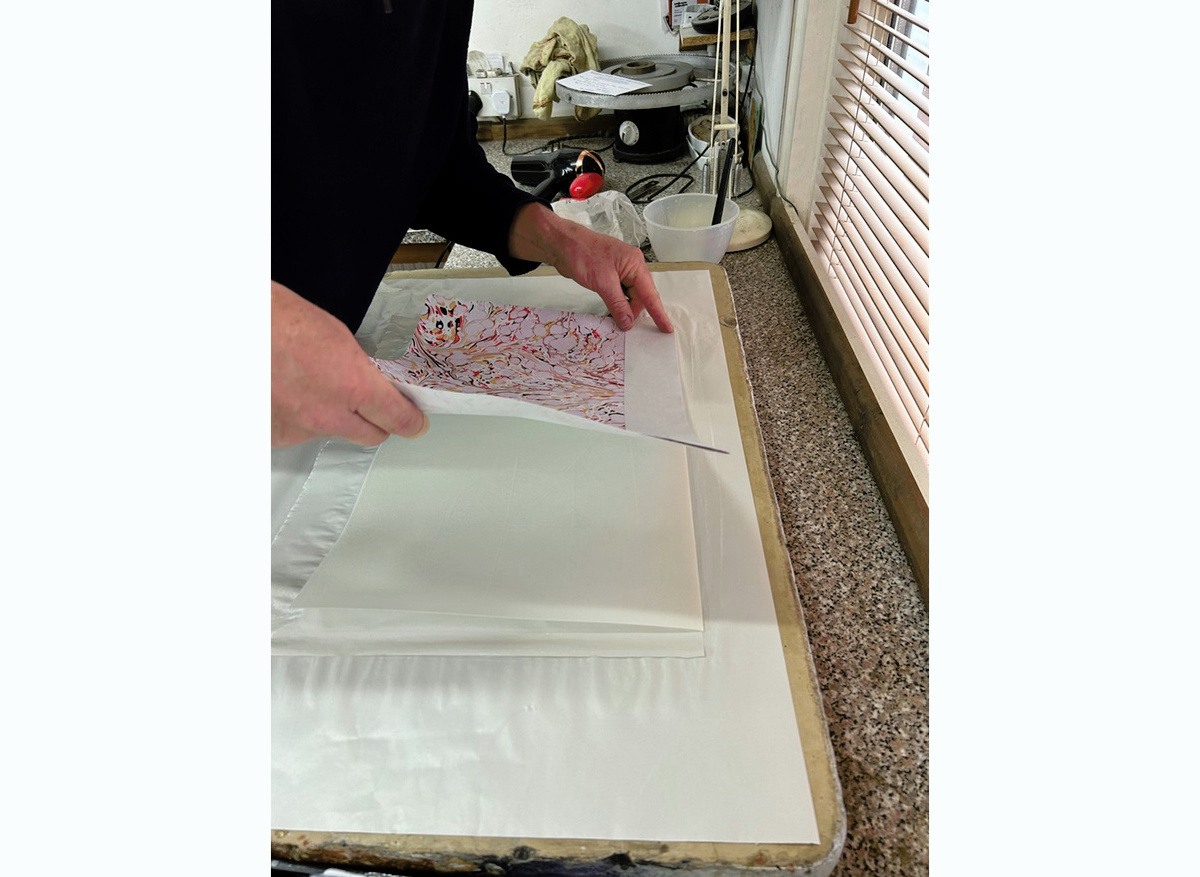
Laying down the marbled paper onto the glued vellum
The text blocks were then gilt on all edges. Preparation of vellum leaves for gilding is no different to paper, just considerably harder work, vellum is horribly robust!
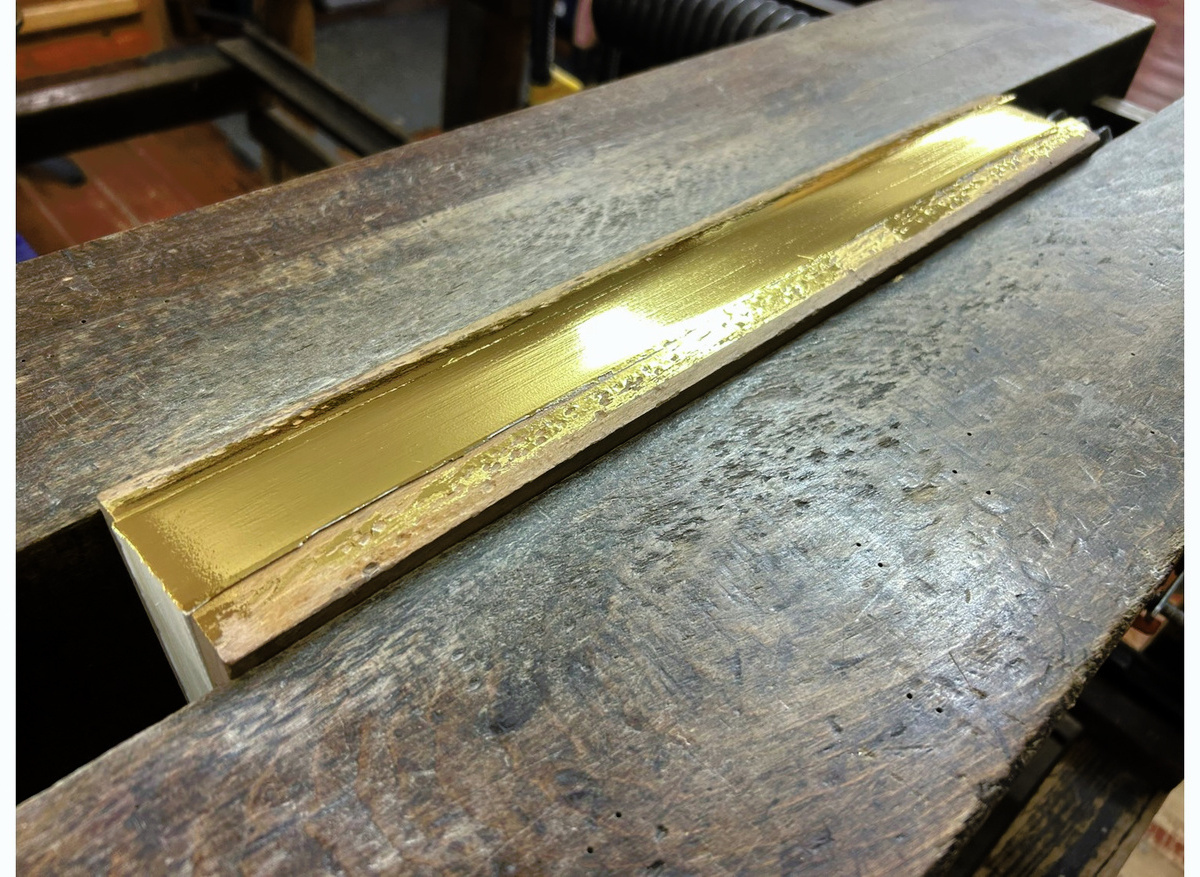
A gilt edge
Sewing and Structure
Next came sewing. The design drawn up by my father in 2004 used the raised cords as part of the strapwork design. This meant that the sewing positions needed to be exact. We prepared a jig and pre-punched all sewing holes to ensure accuracy. Jackie, our assistant for over 20 years, (and to be honest part of the family!) sewed all four volumes on double cords and used double 18/5 thread for strength and to add some swelling to the spine edge. We had to gain enough swell to cope with the 8mm thick oak boards that were to be laced on later.
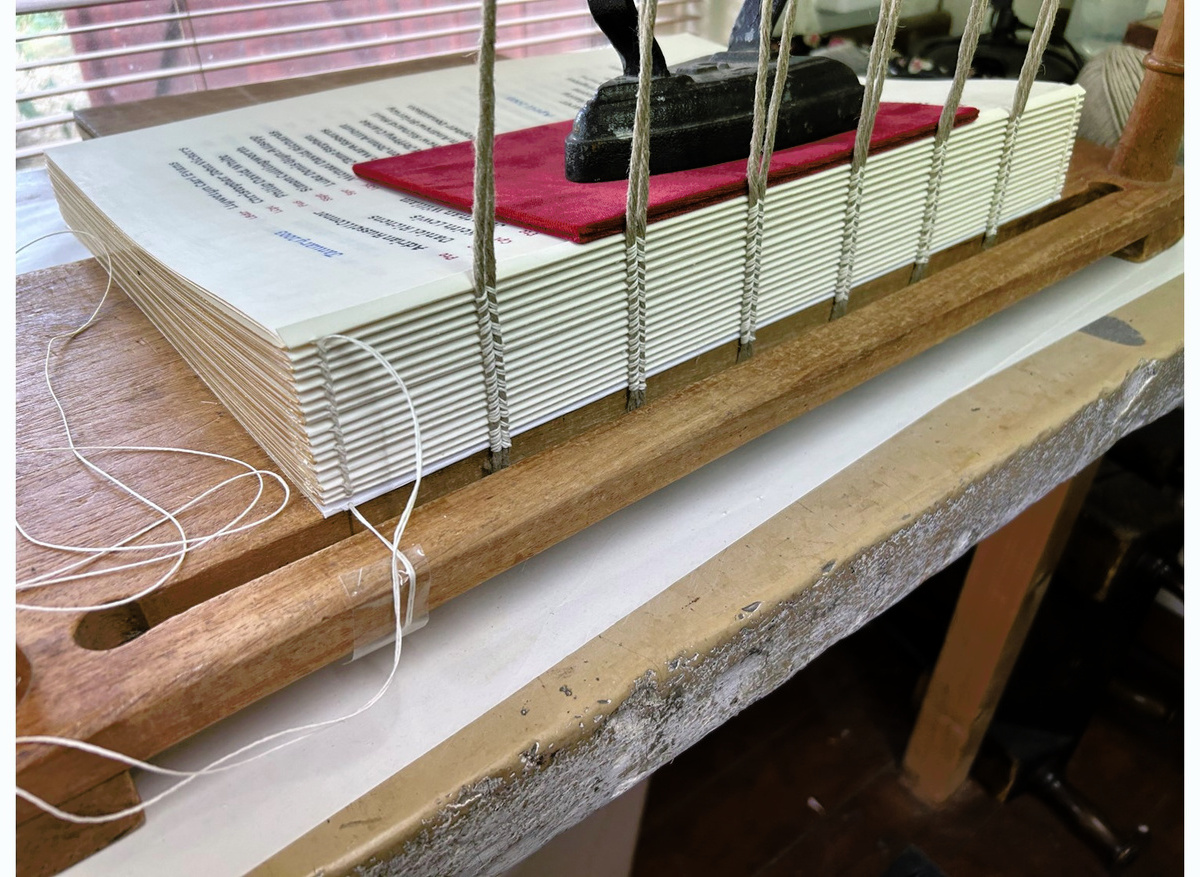
Sewing on double cords
Following on from sewing we began preparing the oak – by now very well-seasoned. The planks were roughly cut into eight over size pieces and reduced to 8mm with a plane.
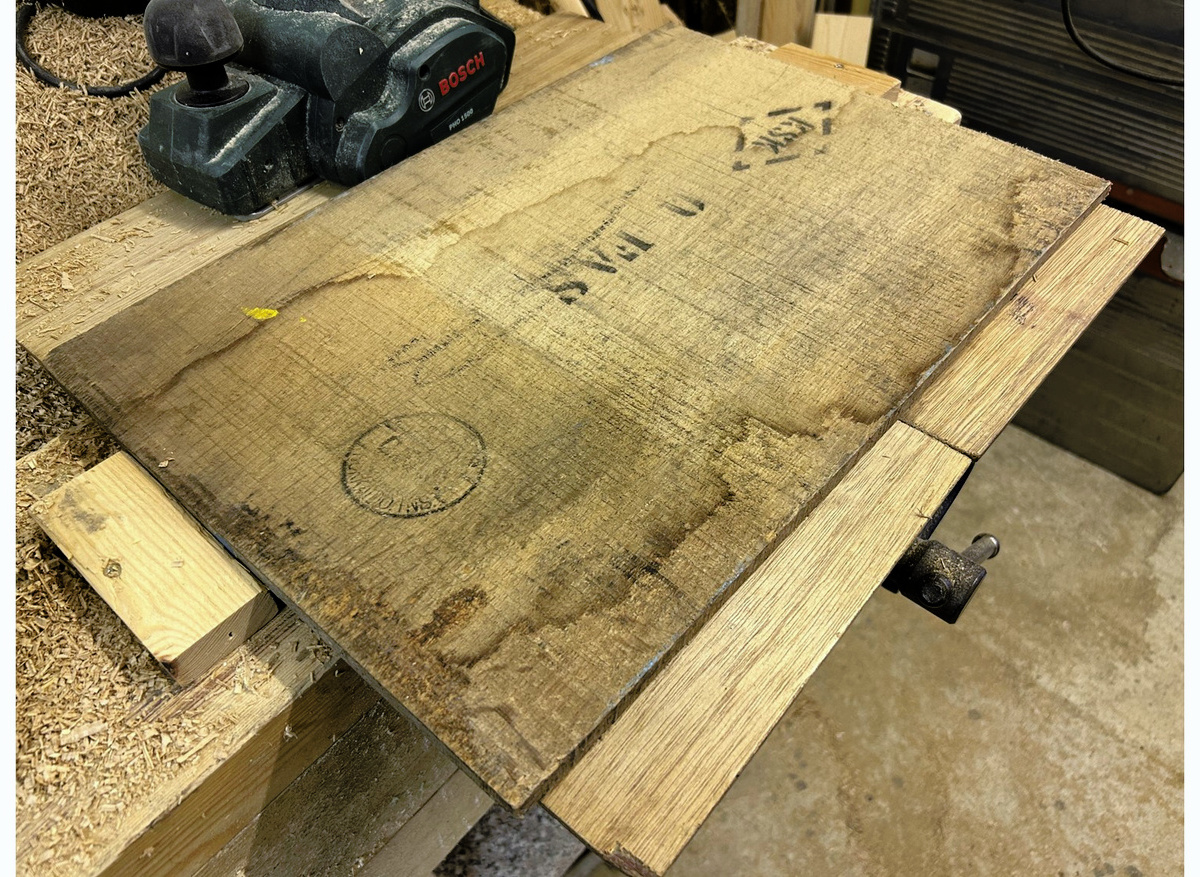
The raw oak
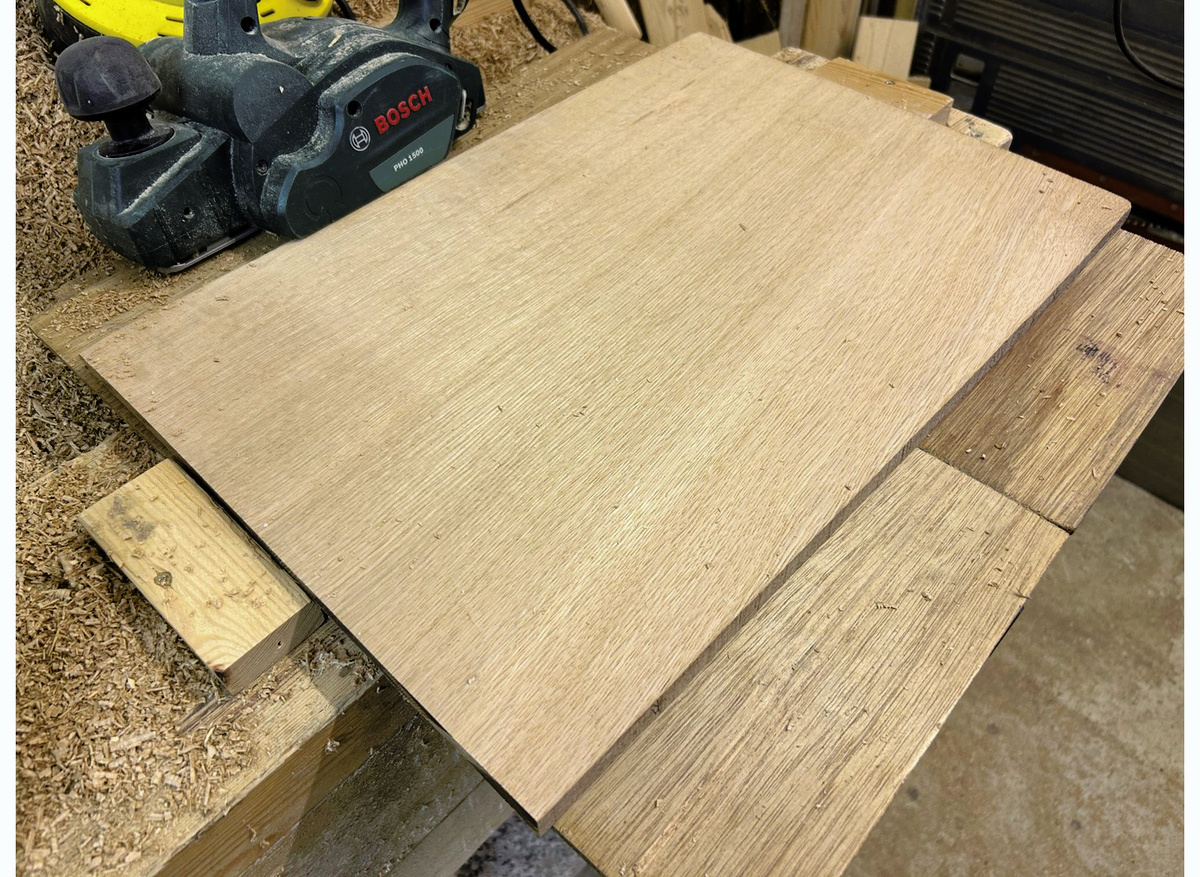
The oak once reduced to the required thickness
The books were then glued up with gelatine and rounded and backed. Due to the robustness of the vellum leaves a shoulder around 50 degrees or so was all that could be achieved – just enough to give support to the boards when attached.
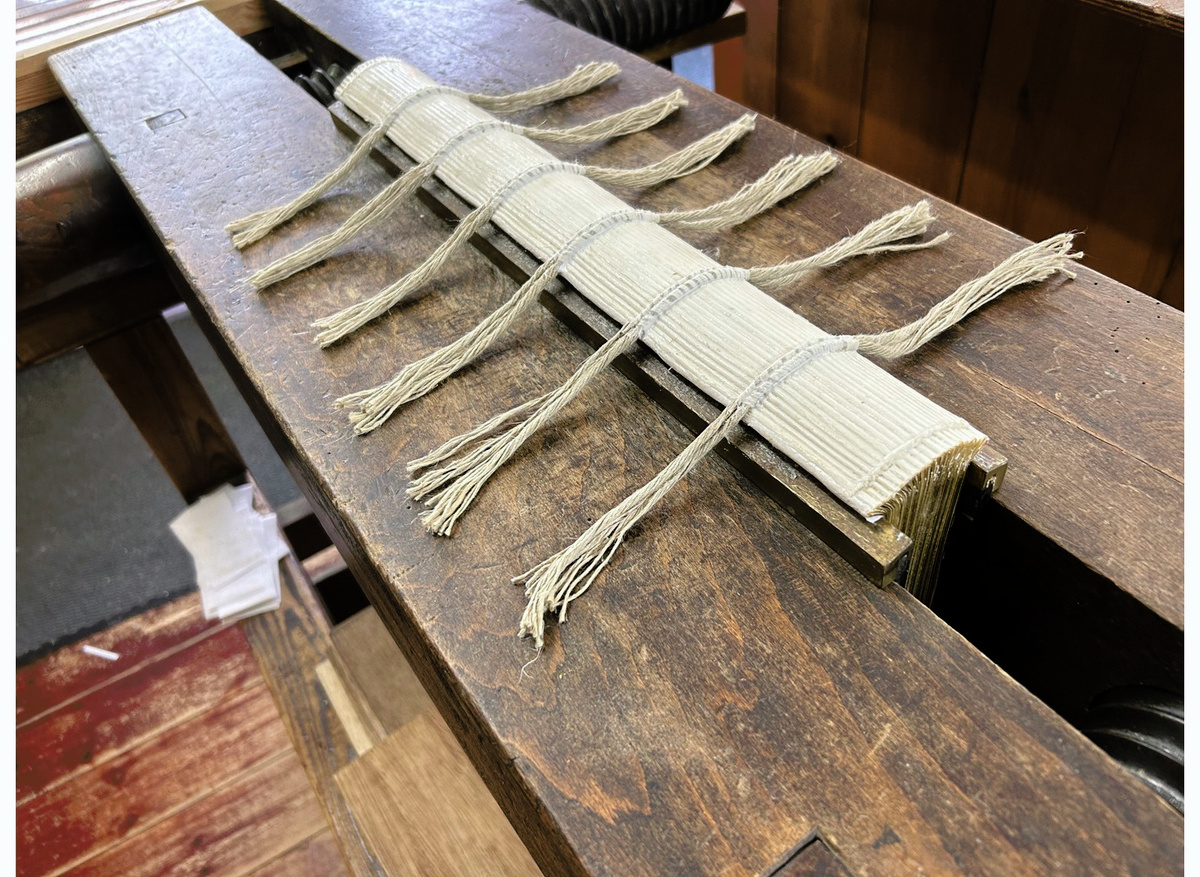
Rounding and backing
The boards were then profiled at the spine edge to match the backing and cut to size.
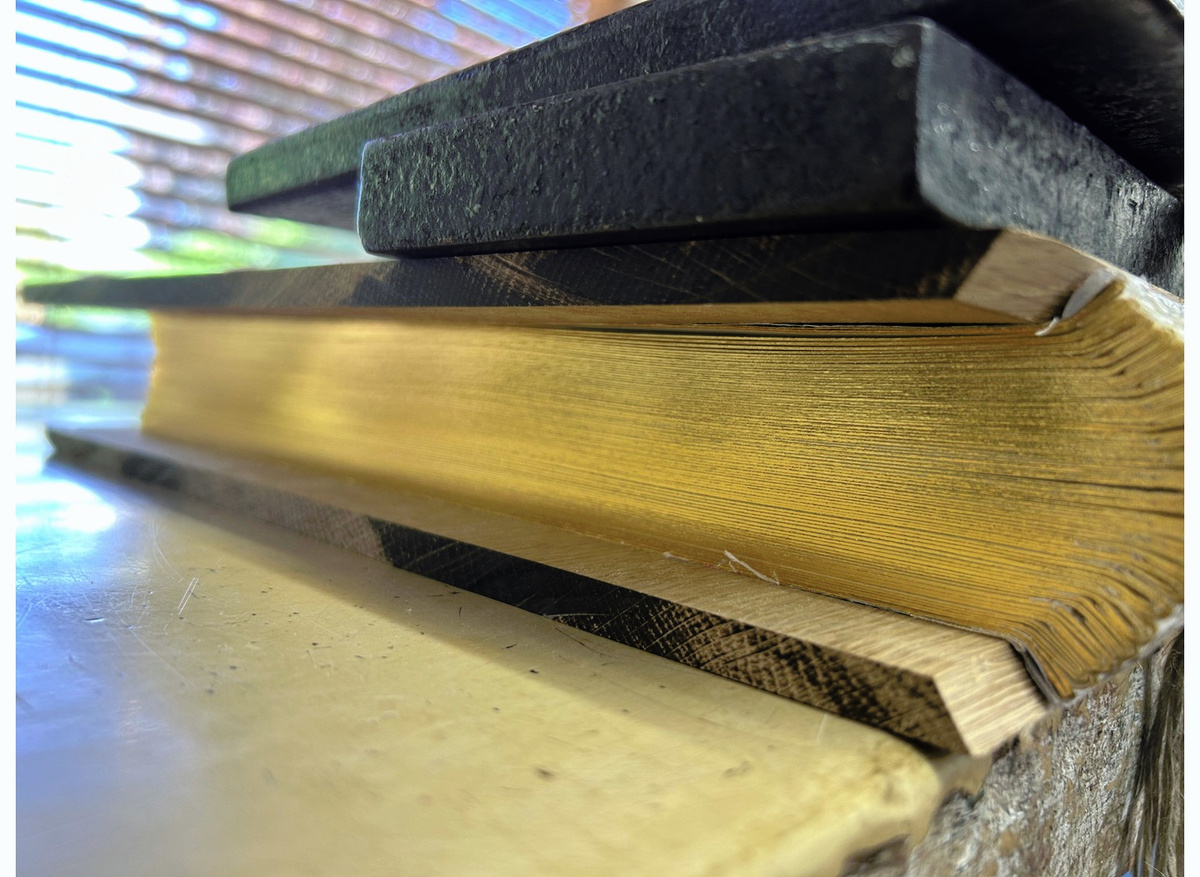
Oak boards profiled at the spine edge to match the angle of the backing
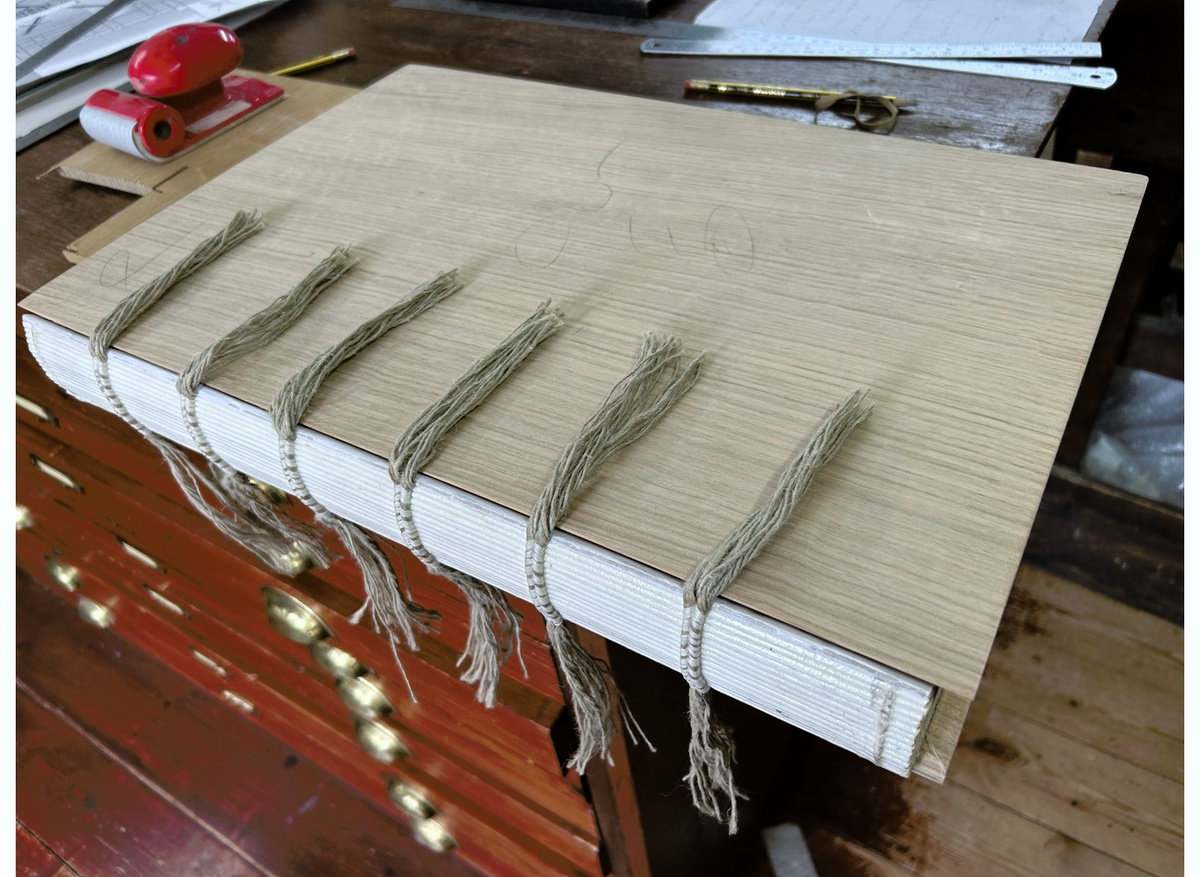
Oak boards cut to size with approximately 9mm squares
The inside of the boards were planed with a 45 degree bevel around three sides and lightly profiled or cushioned on the outside. Holes and channels were then cut to enable lacing on.
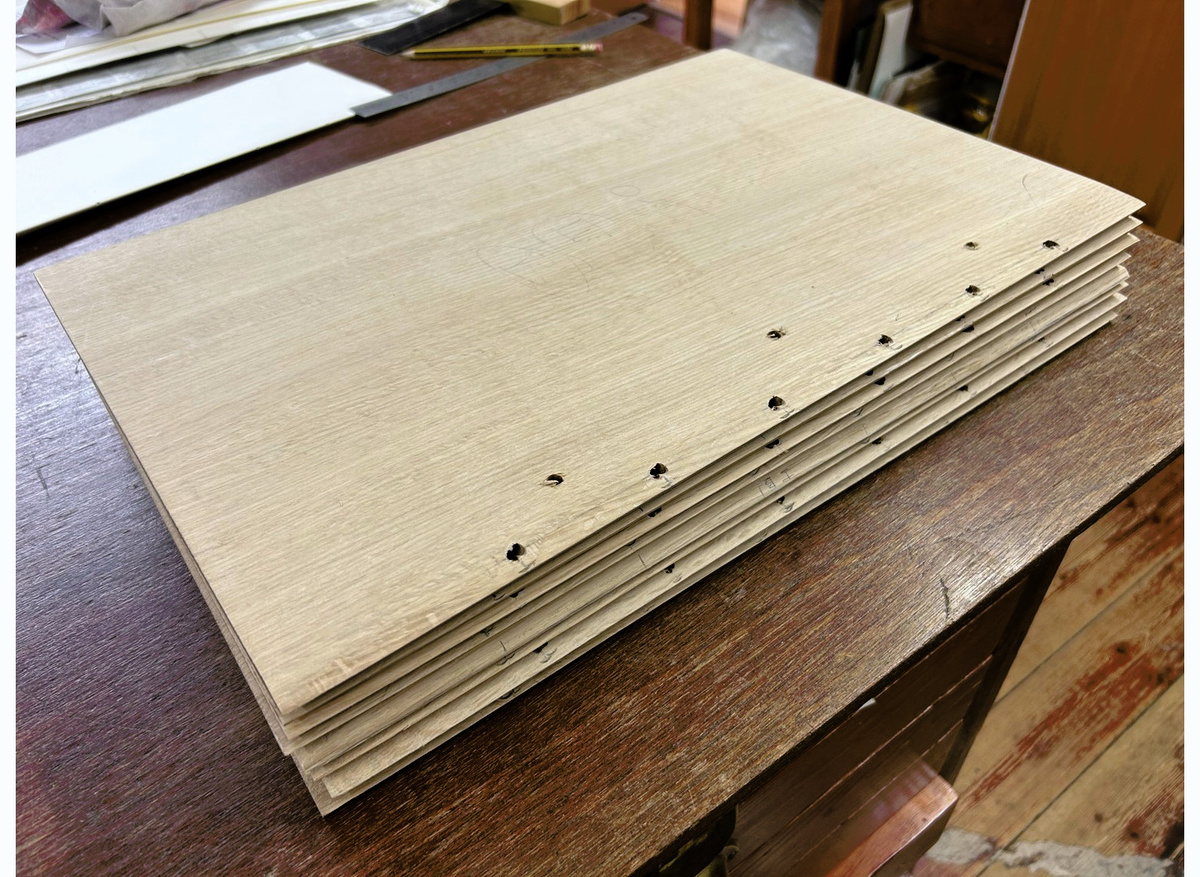
All eight boards, cushioned and drilled in preparation for lacing on
Quarter sawn oak is an incredibly stable material. That said, we want these bindings to last for centuries to come. We therfore isolated the potentially acidic oak by lining with acid free paper adhered with PVA. This not only isolates the leather from the oak but also prevents too much moisture getting to the oak during covering – the leather is put on damp and with paste. The images show the holes and slots inside and outside the boards. The brown tape in the images is parcel tape. This is stuck to the waste-sheet to prevent moisture from getting to the text block during lacing on the boards. The wastesheet is removed later, before pasting down, so the tape is only temporarily in place during binding.
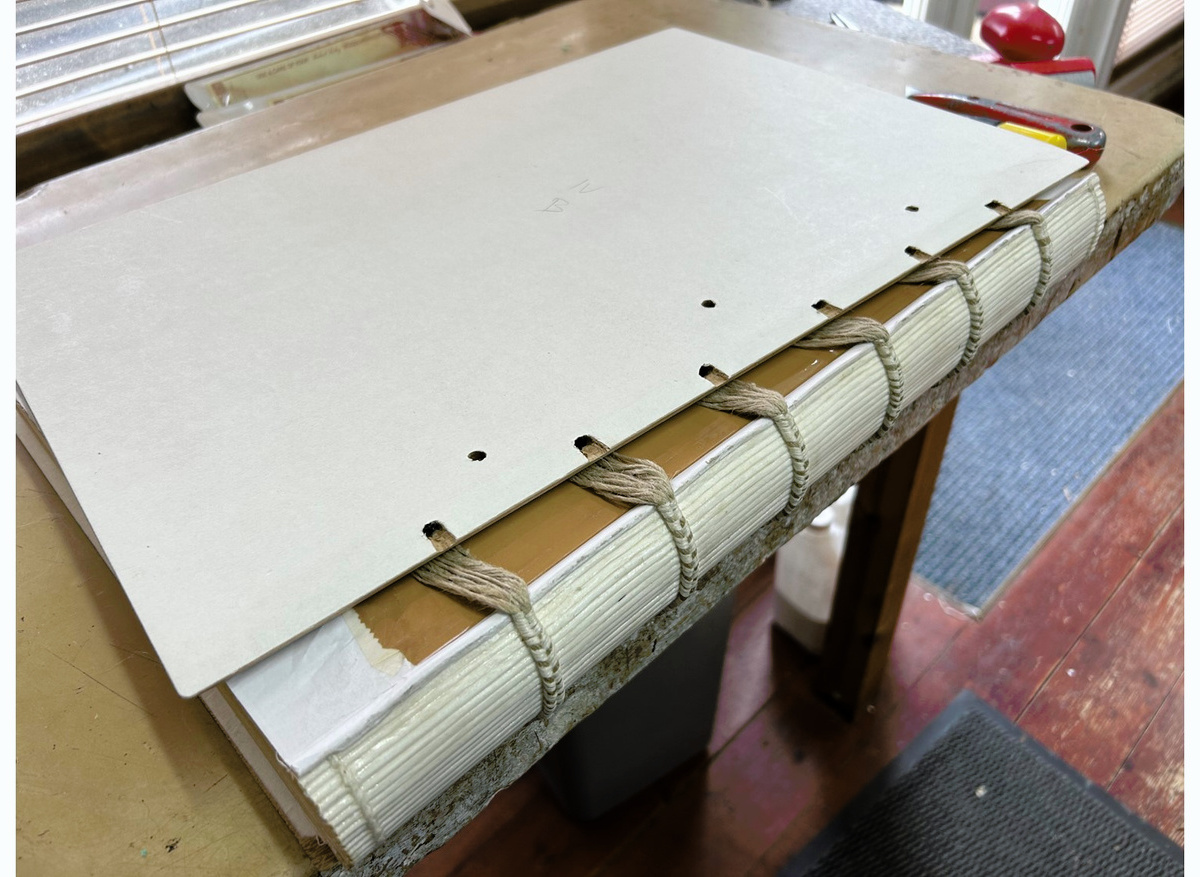
Shows the outside of a board covered with acid free paper and slots cut for lacing
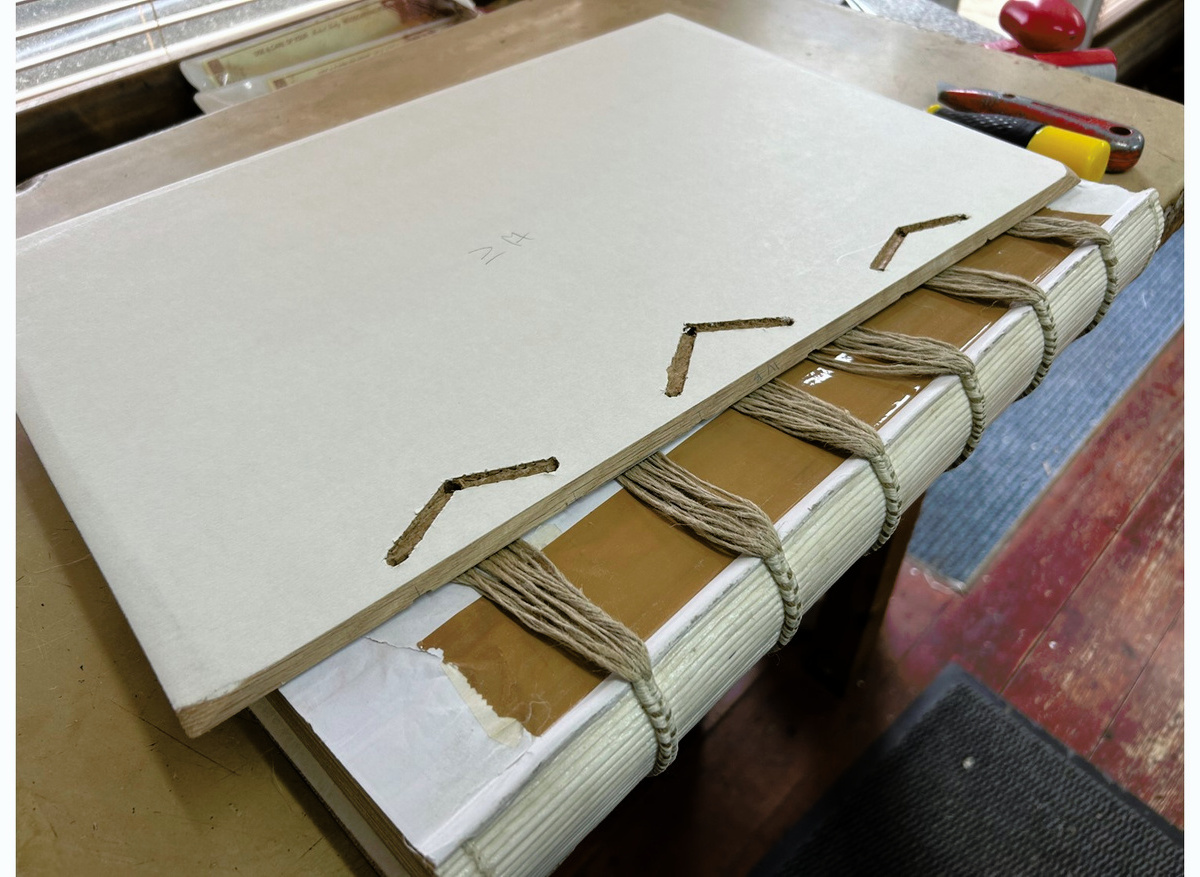
Shows the inside of a board covered with acid free paper and slots cut for lacing
Covering, Tooling, and Clasps
The boards were then laced on – with the cords being held with specially profiled softwood pegs. The pegs are oval shaped to prevent stress across the grain of the oak, therefore reducing the possibility of the wood splitting.
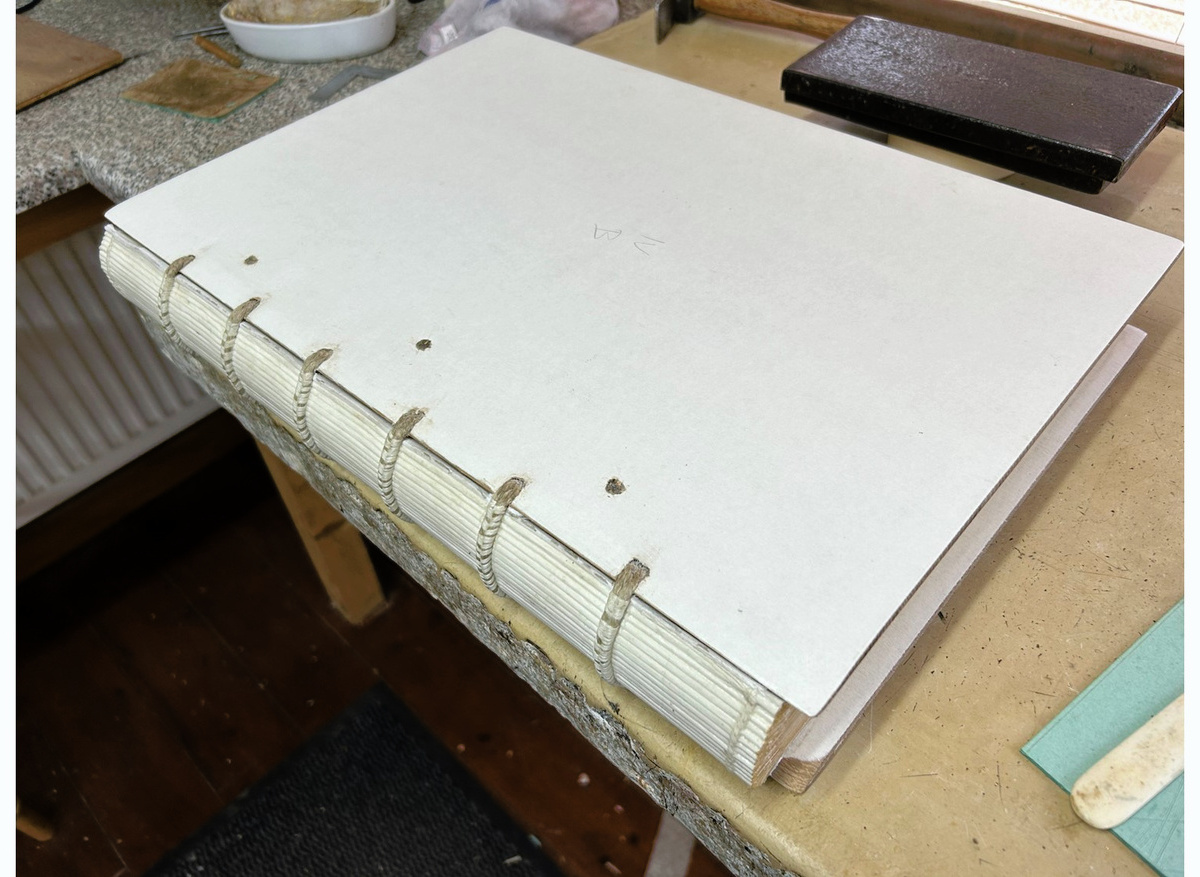
Boards laced on with oval softwood pegs to hold cords in place
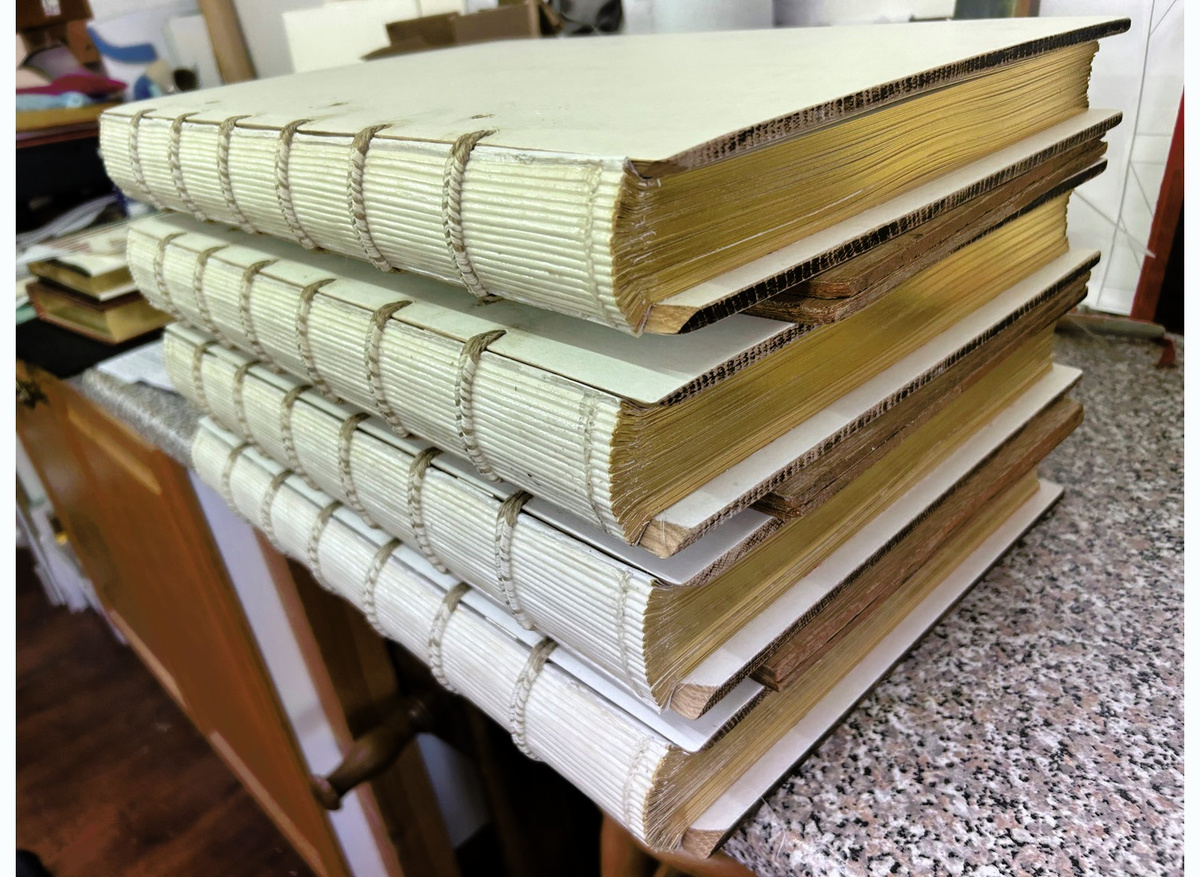
All four volumes with the boards laced on
Double endbands were then sewn on – red black and gold, and the spines lined with unbleached cotton and thick vellum. This was allowed to dry while bandaged up to ensure good adhesion. Then, a thin fleshing was added to the spines allowing us to sand out any undulations from the endbands etc. The text blocks were capped up with paper and cling film for protection.
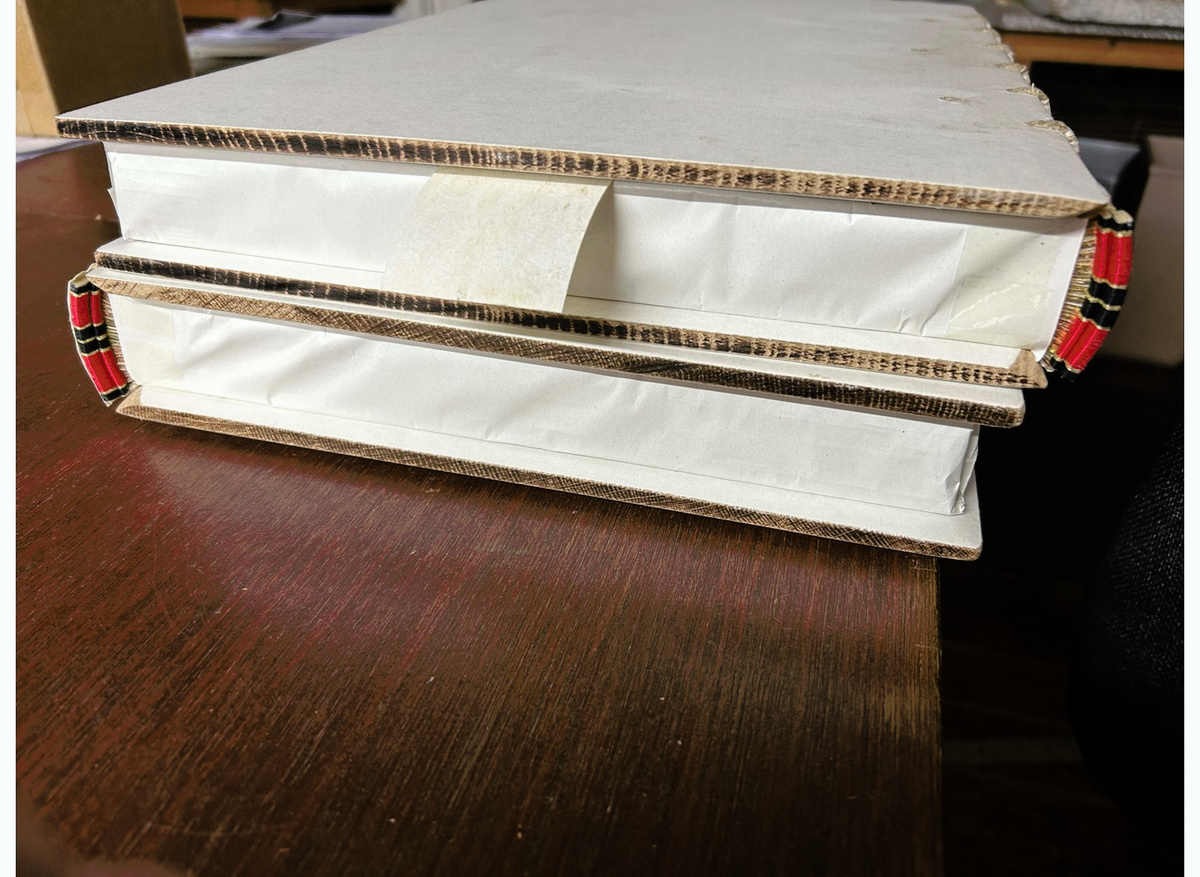
Endbands sewn
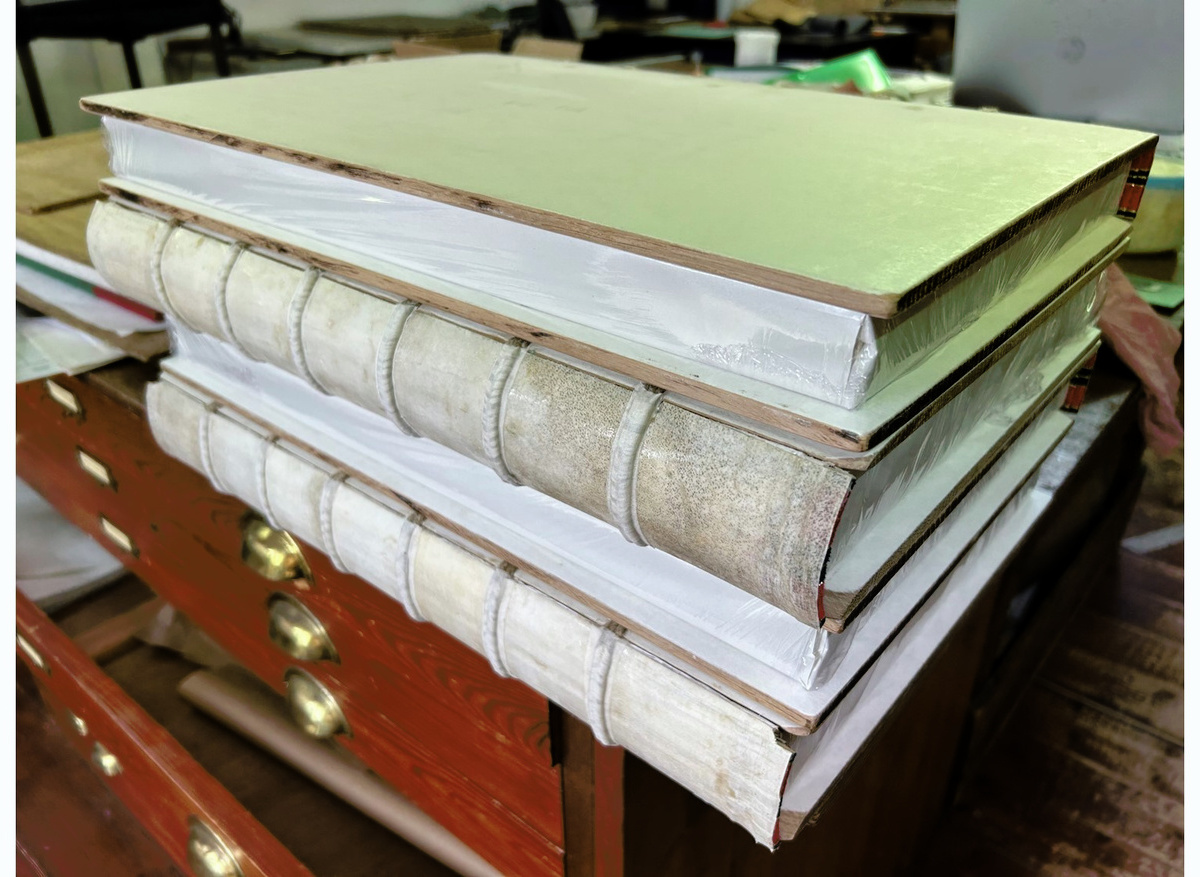
Spines lined with cotton then vellum
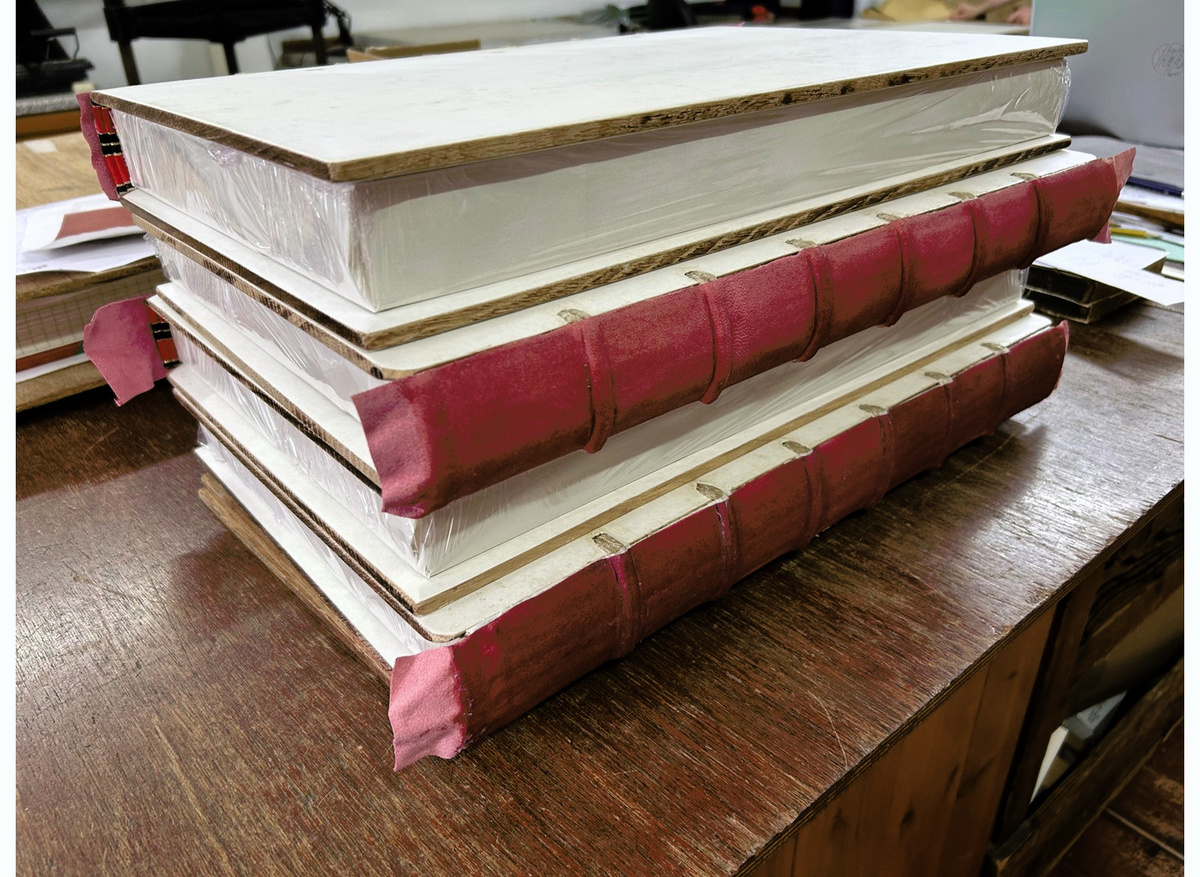
Spines lined with a thin fleshing
The books were then covered – The well matured Harmatan goatskin was finally put to use!
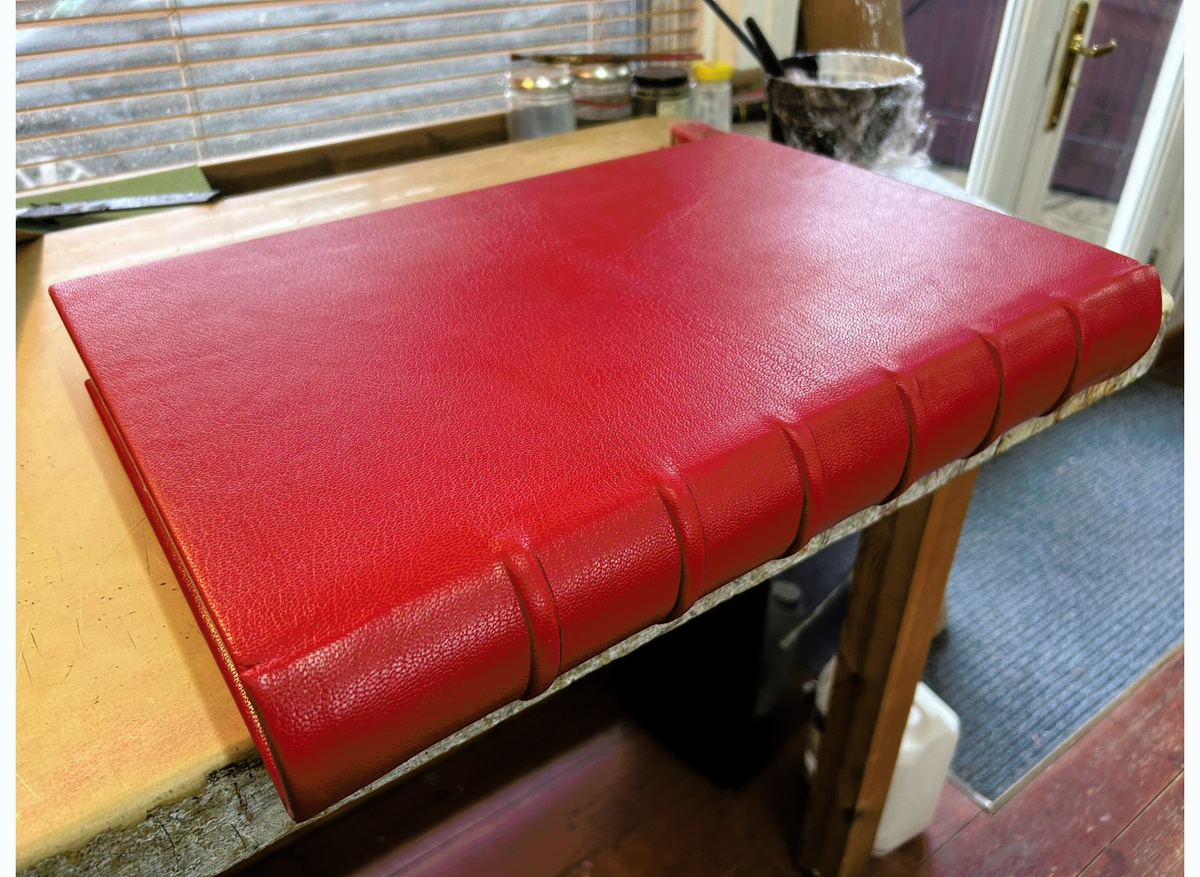
A covered volume
Once fully dry and the boards “stabilised”, with the addition of strong acid free Kraft paper to the inside, it was time to begin tooling. The design from 2004 was redrawn to the exact dimensions of the four volumes and a tooling procedure worked out. The method used involved masking off the areas to be left un-tooled, therefore reducing the risk of tooling beyond where required.
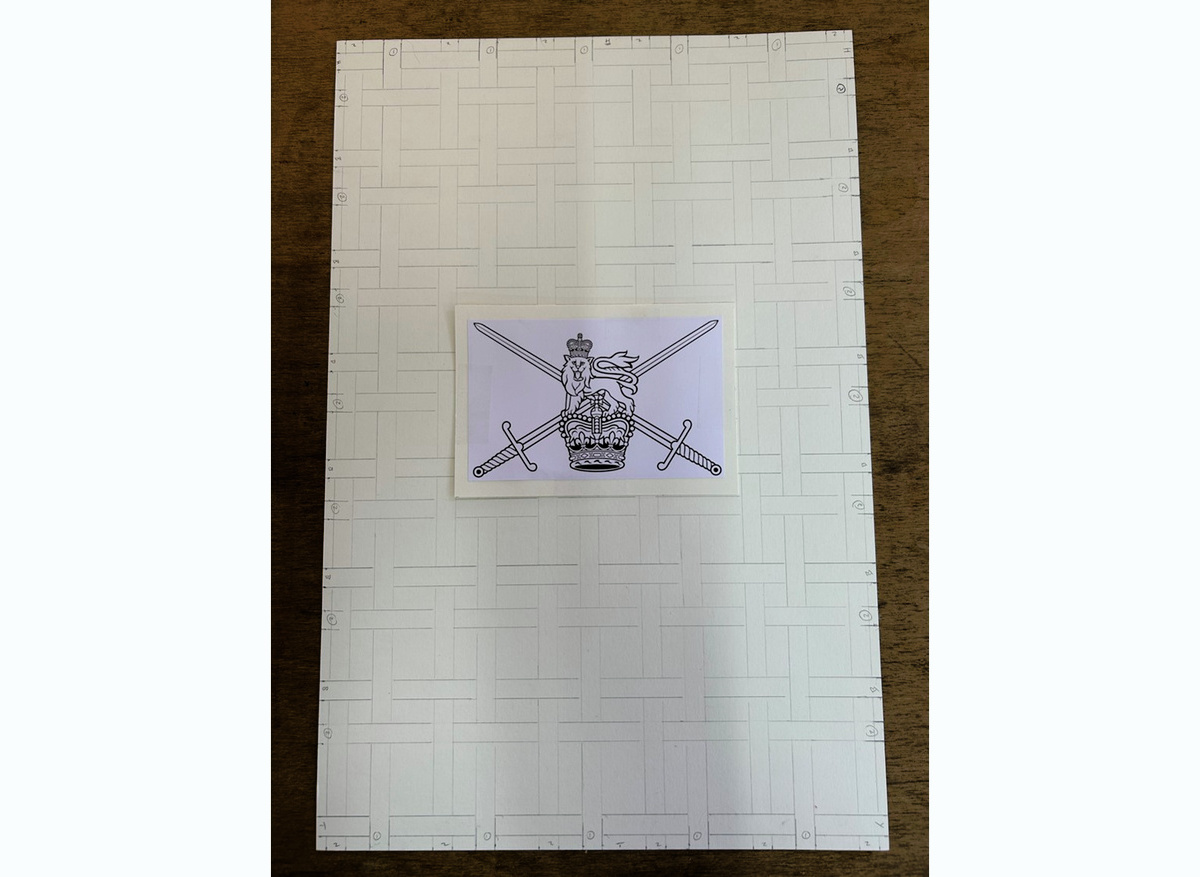
Design for front boards
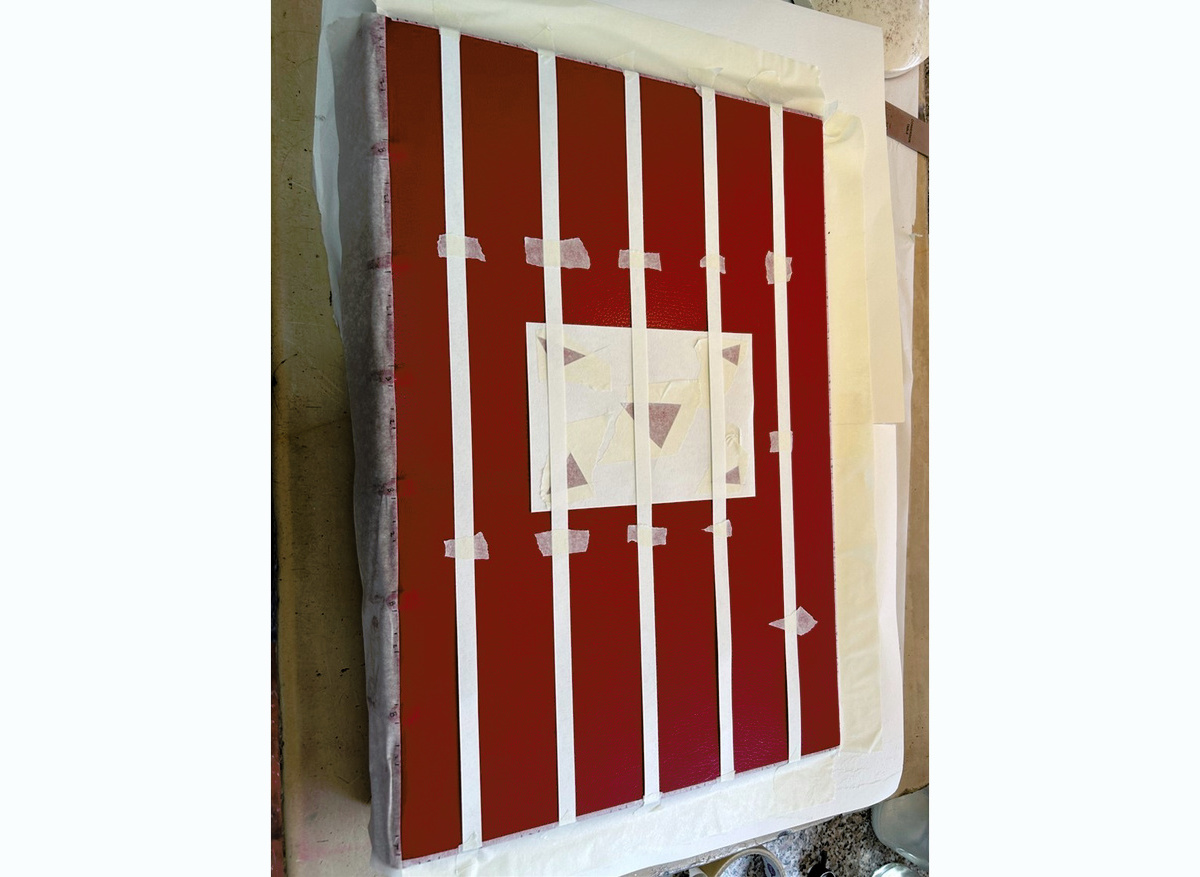
Masked off for tooling
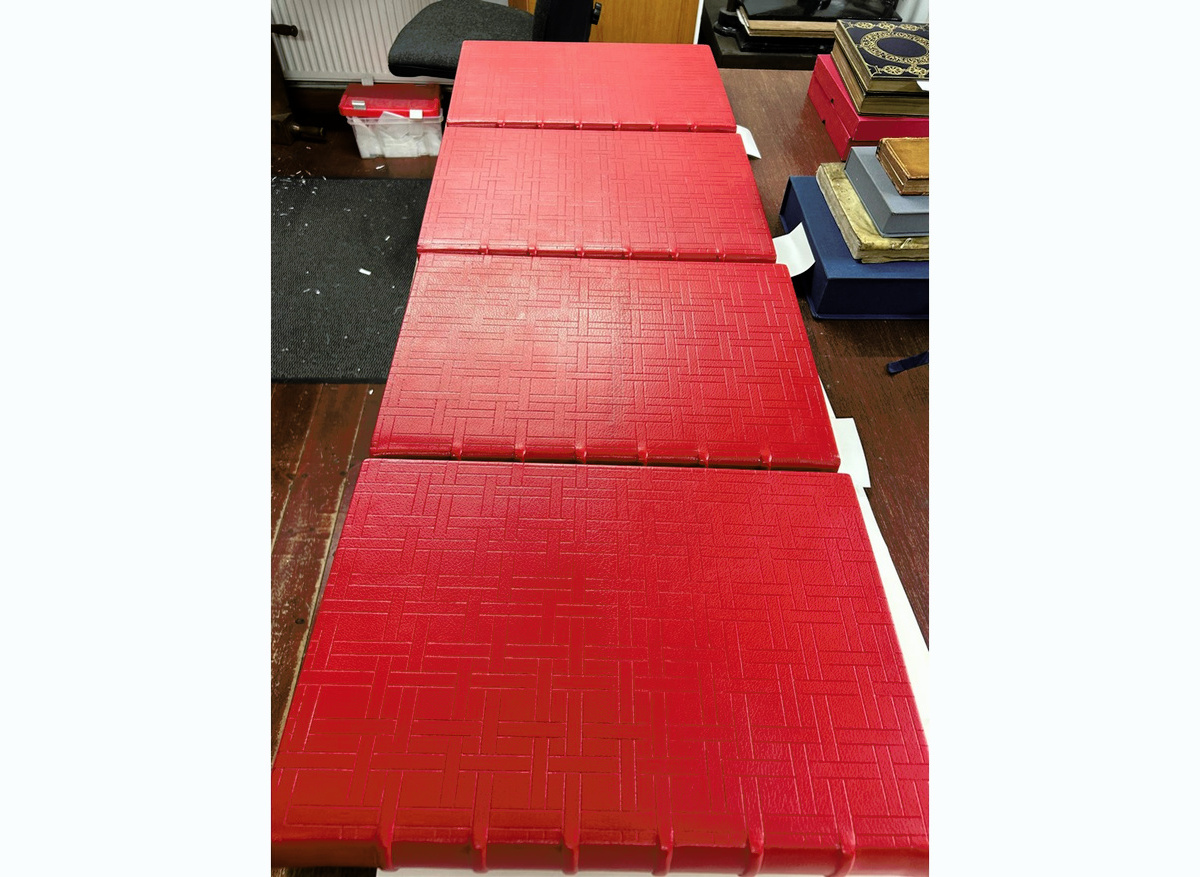
All rear boards blind tooled
The centre section of each front board was then cut out to the nearest blind line using an angled cut. The pieces of leather removed were then blocked in gold leaf and reinserted into their original locations. This was fiddly, but allowed us to concentrate purely on the design being applied and meant we didn’t require an enormous blocking press!
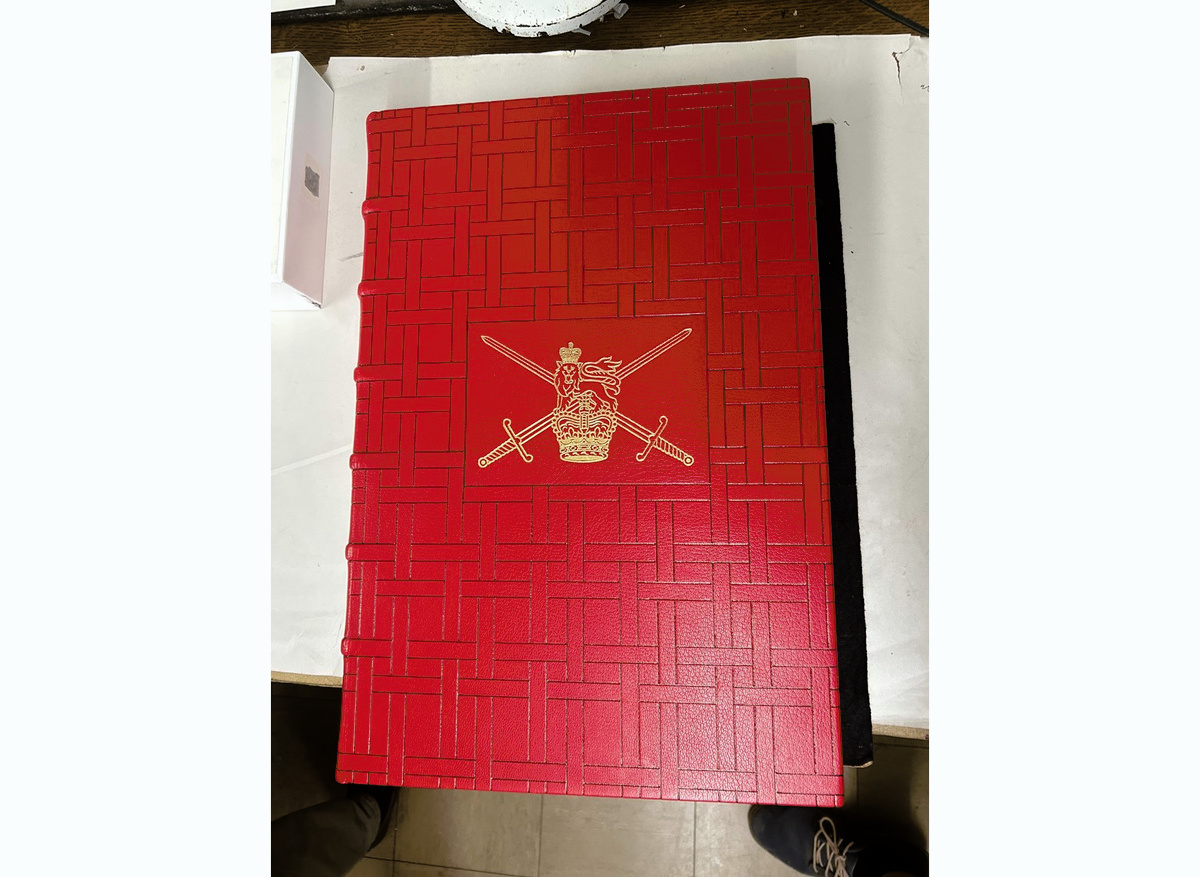
Blind tooling to front board with Army crest added in gold leaf
The boards were all tooled with a rash of gold dots at all crossovers within the strapwork design, as well as a “tank track” style patterned roll around the turnins.
The clasps were made to a design we have used previously – what we call a dumbbell clasp. It consists of cuboid blocks of silver, soldered to rods that are then inserted into the fore-edge of the boards. One pair of cuboids per clasp are drilled to accept a hinge pin, the other two per clasp are machined with a recess on the top edge to accept the cylindrical dumbbell – a separate component. This meant that for the four volumes there were a great number of parts. All the components were made from Stirling Silver and soldered with hall marking quality solder. They were then cleaned up and sent away for gold plating.
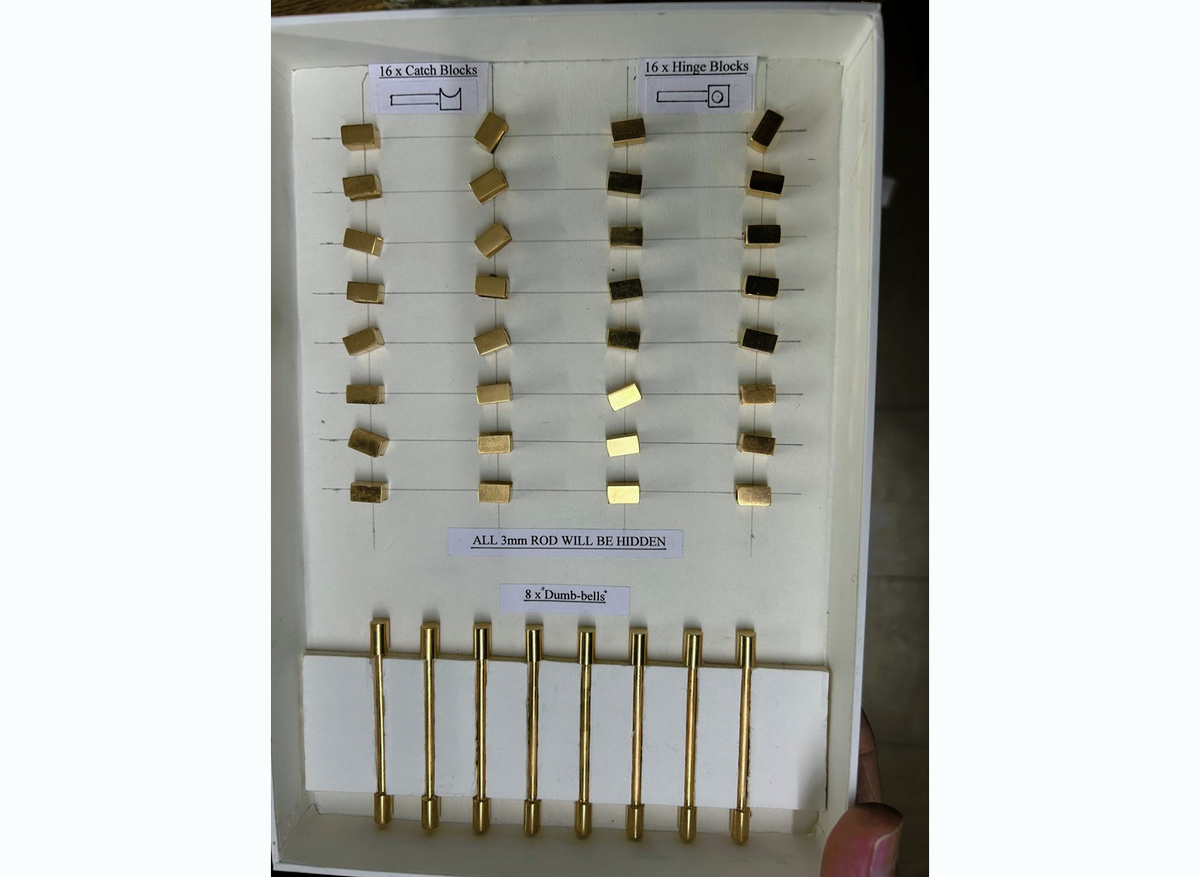
Clasp components once gold plated
The clasps were made up with vellum and brass crossovers for strength and to reduce twist. The crossovers were then covered in matching red goatskin.
With the clasps fitted to one volume and the spines now lettered, it became apparent that as the books were incredibly heavy, support cradles would be required. The image below shows the first mock up of a cradle – each board at approximately 20 degrees and the head lifted to make viewing easier. After a prototype or two, we set about making 4 display cradles and the page weights required to control the thick vellum leaves when the book was on display.
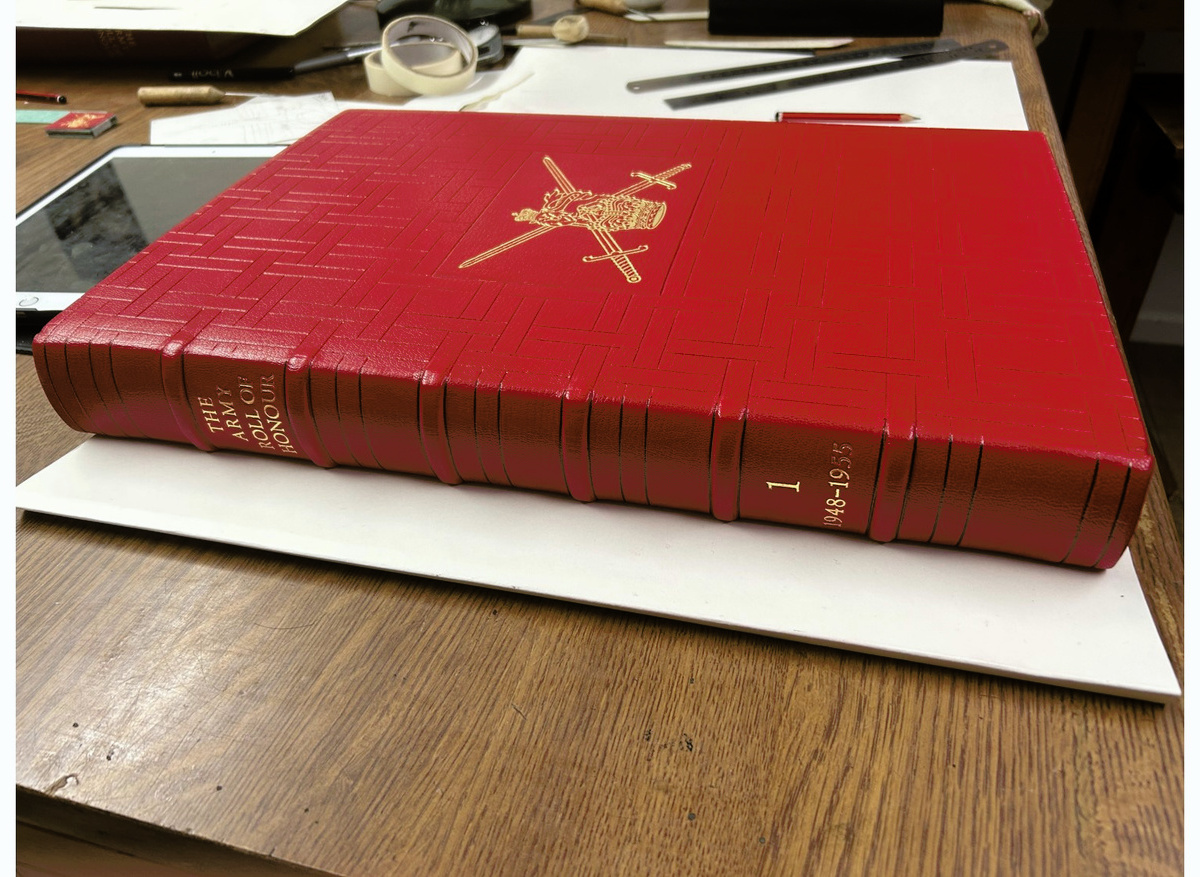
Volume lettered to spine in gold leaf
Working out angles and dimensions for cradles. The clasps have the uncovered vellum/brass crossovers
What resulted was four velvet lined cradles with black plywood bases, dowelled uprights, a recess in each for the spine and supports around three sides to restrict any sliding of the book.
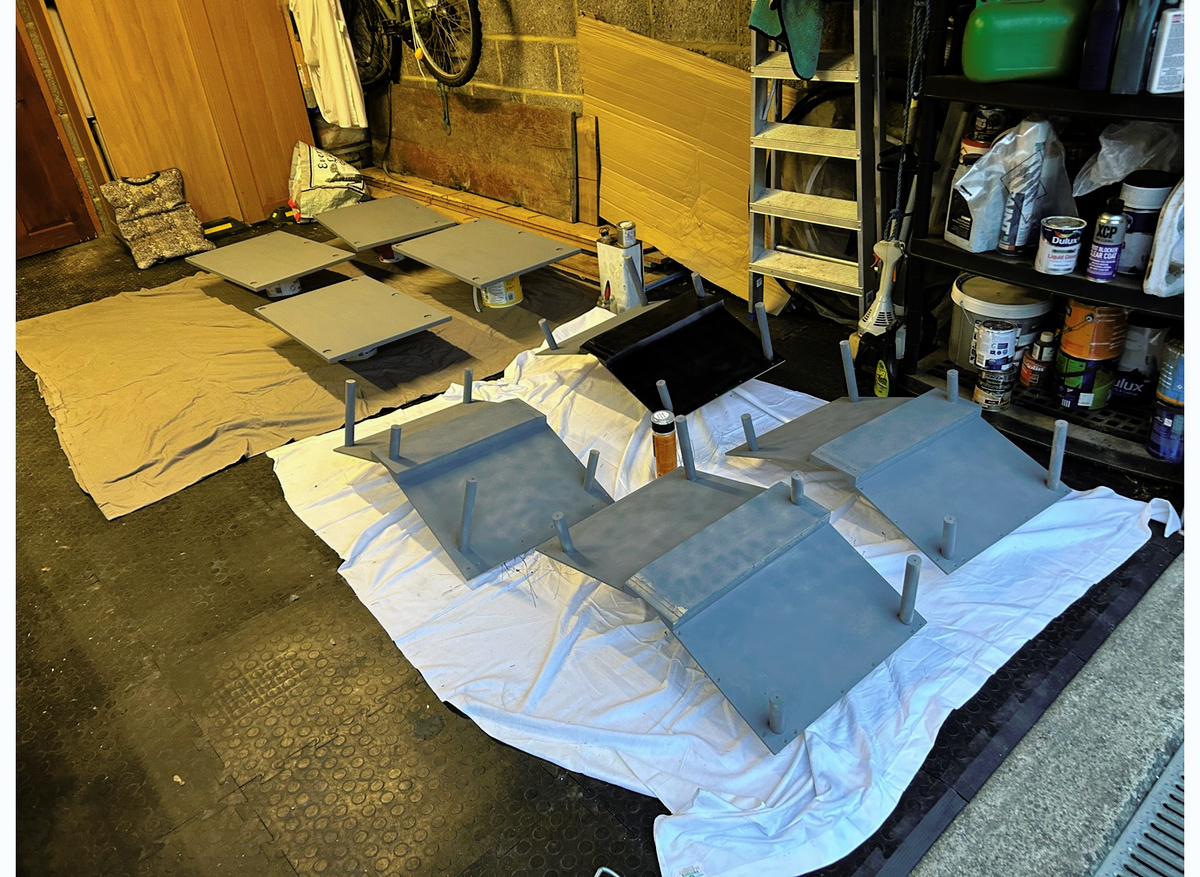
Part assembled cradles being sprayed black in my rather messy garage
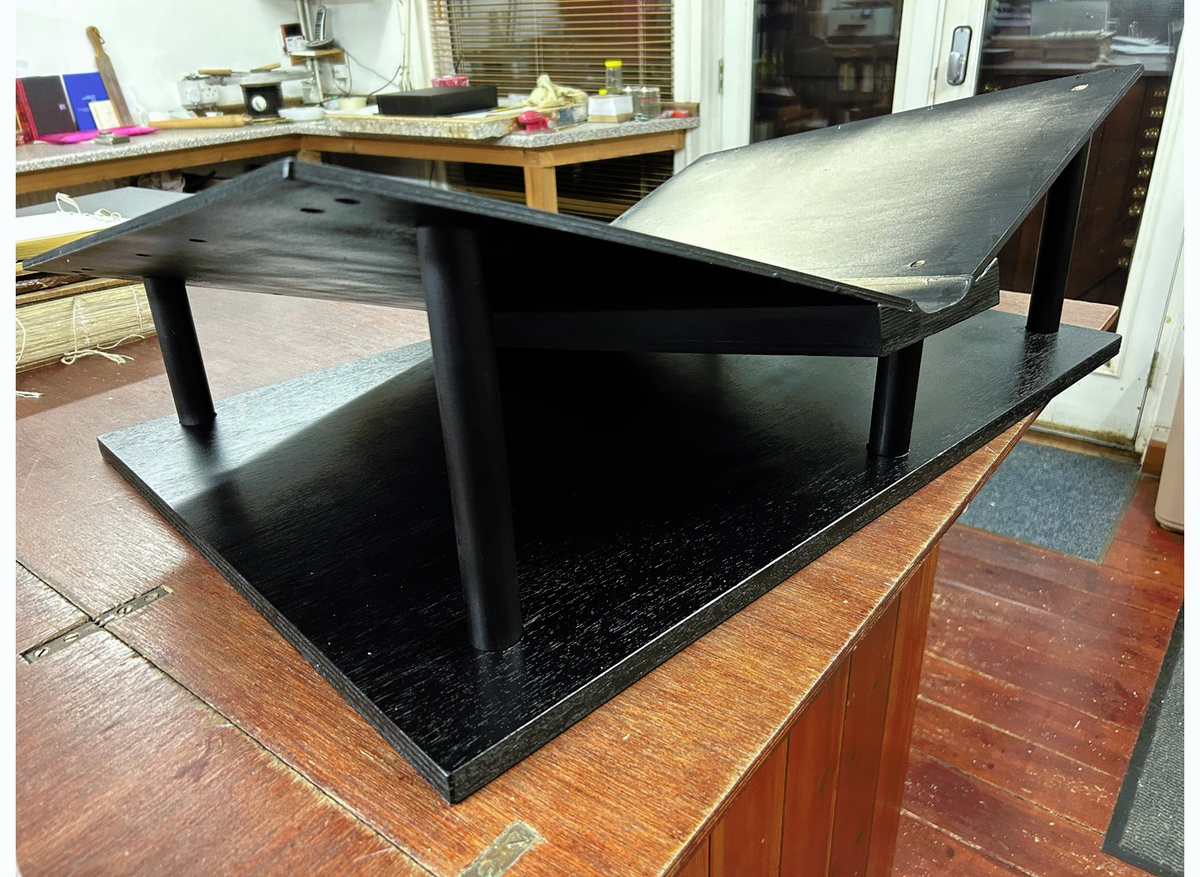
Cradle before velvet added
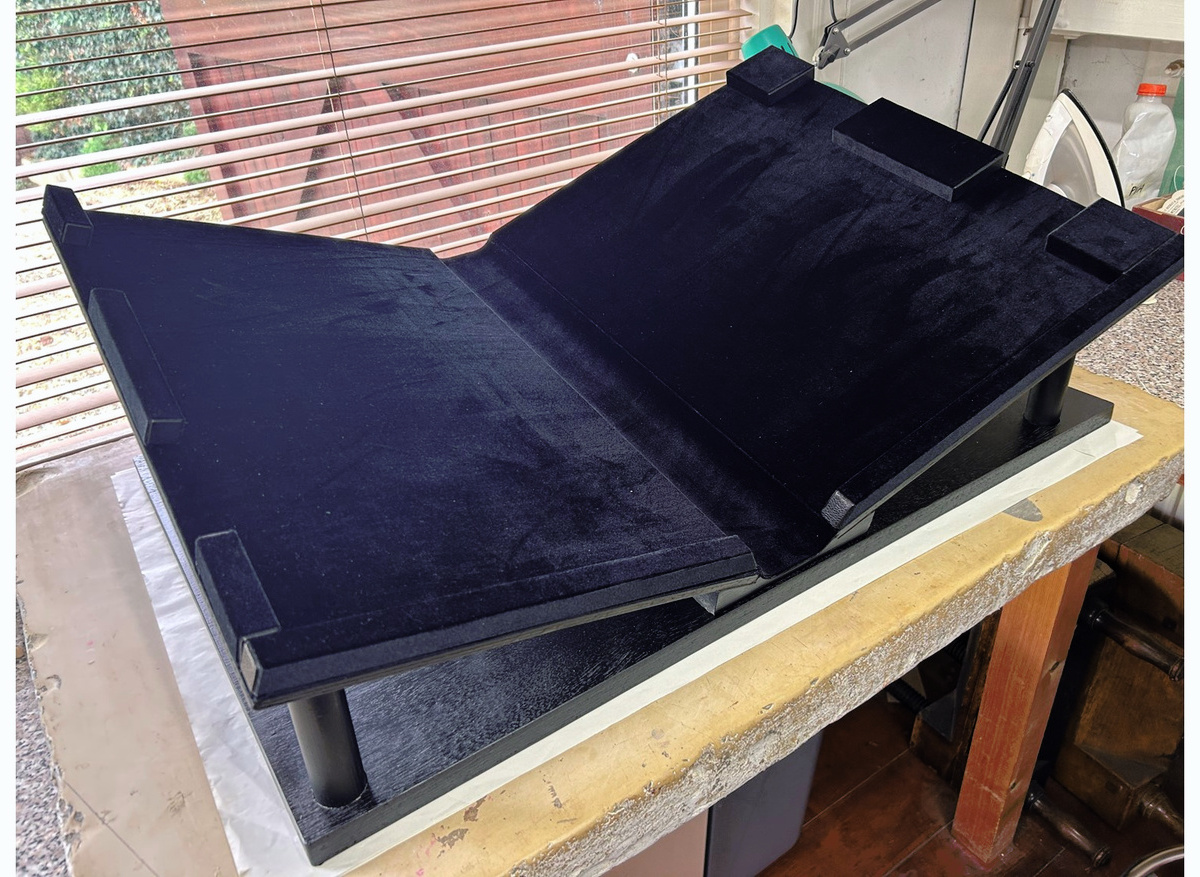
Velvet lined cradle with supports added on 3 sides
The page weights were made from laminations of lead, edged with black leather. These then had red leather panels added to each side, gold blocked with the army crest. The eight page weights were then housed in a lift off cloth box, lined with velvet.
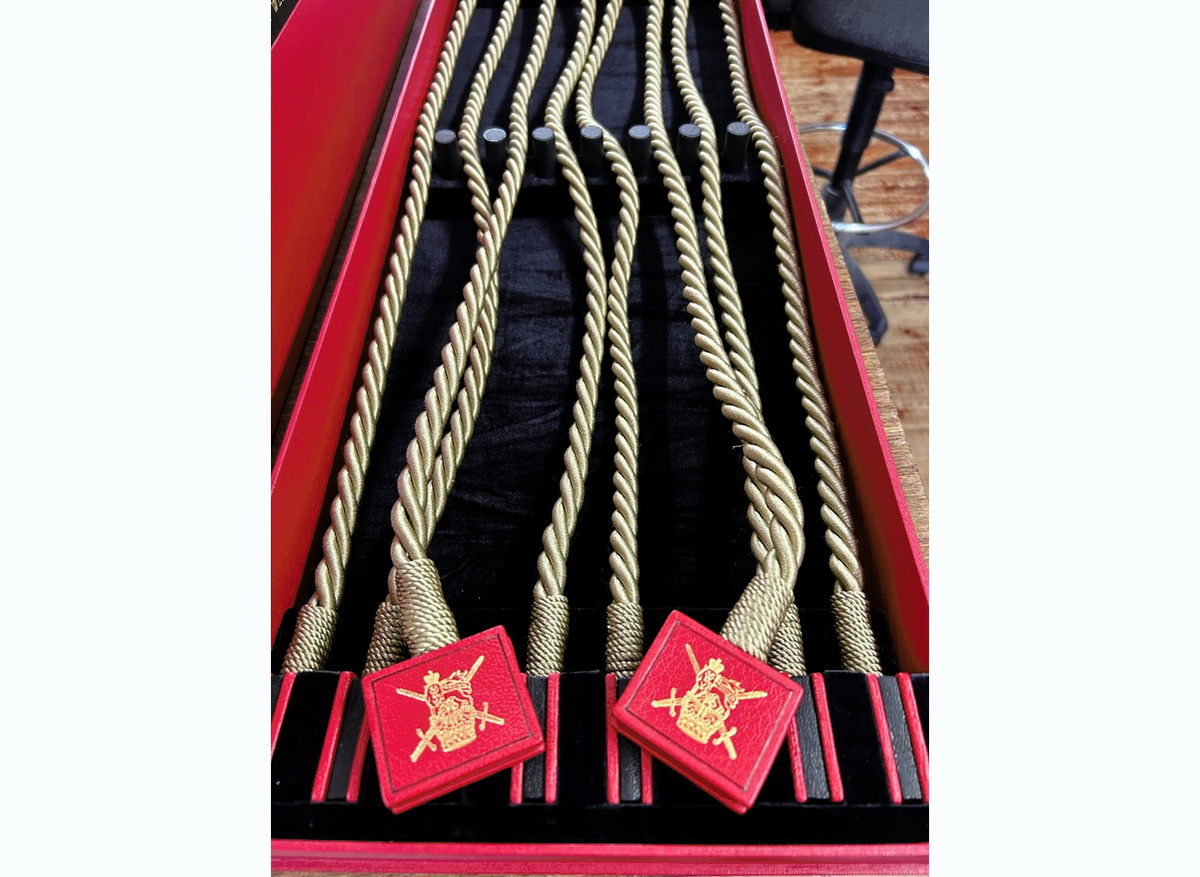
Page weights
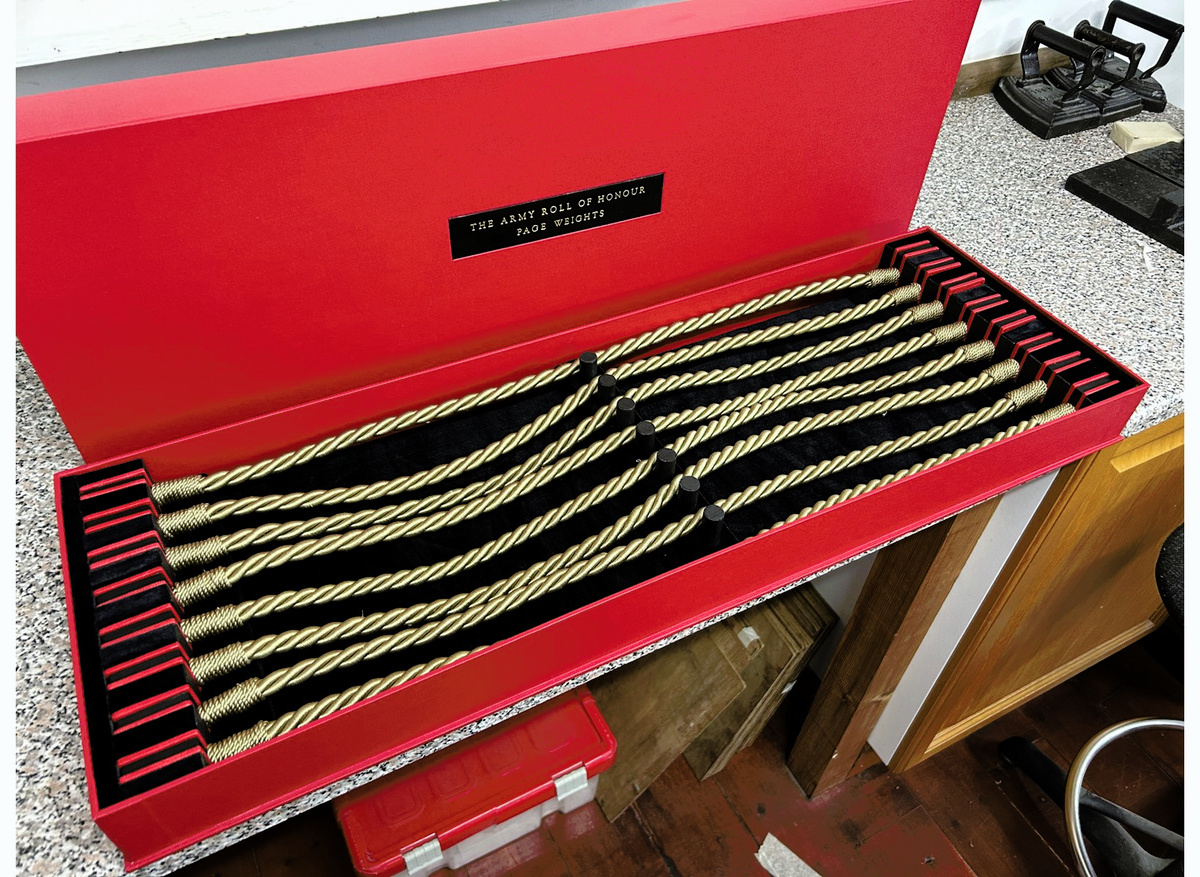
Page weights in box
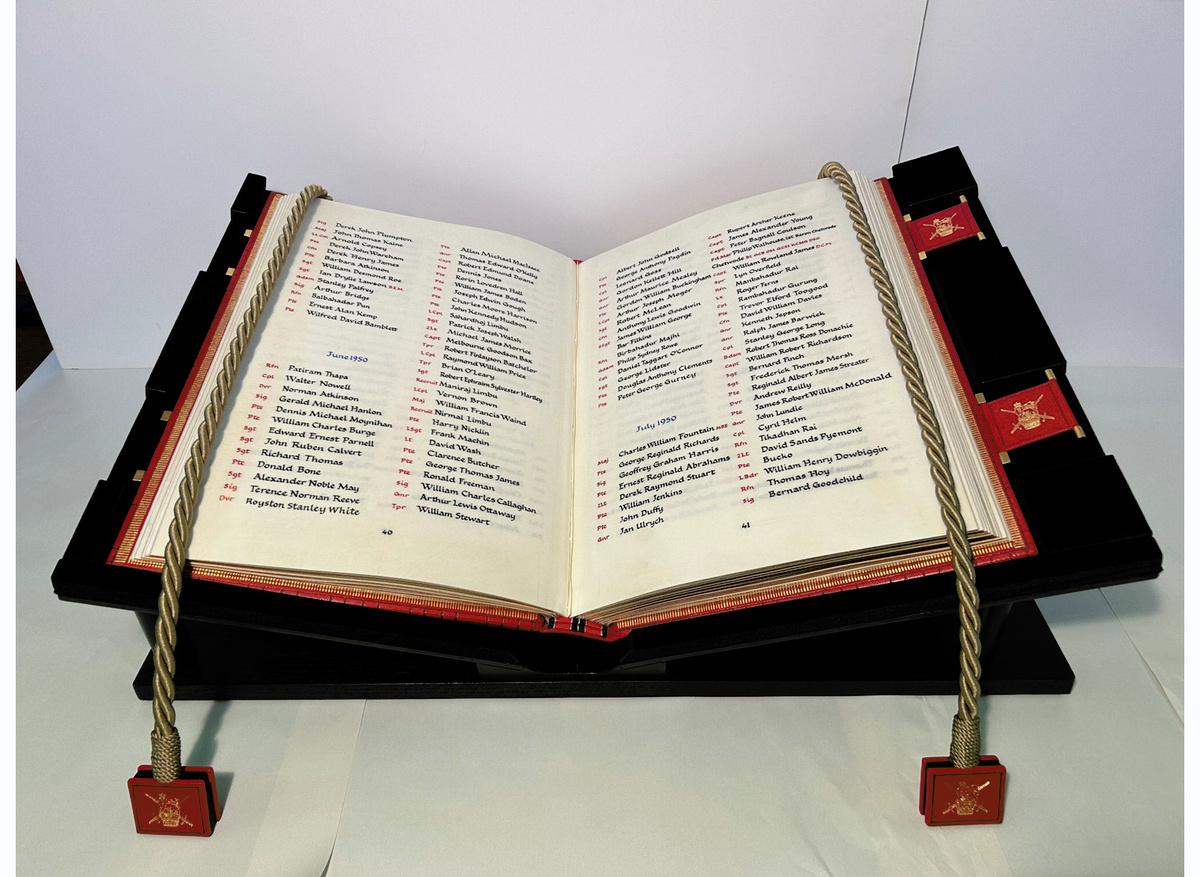
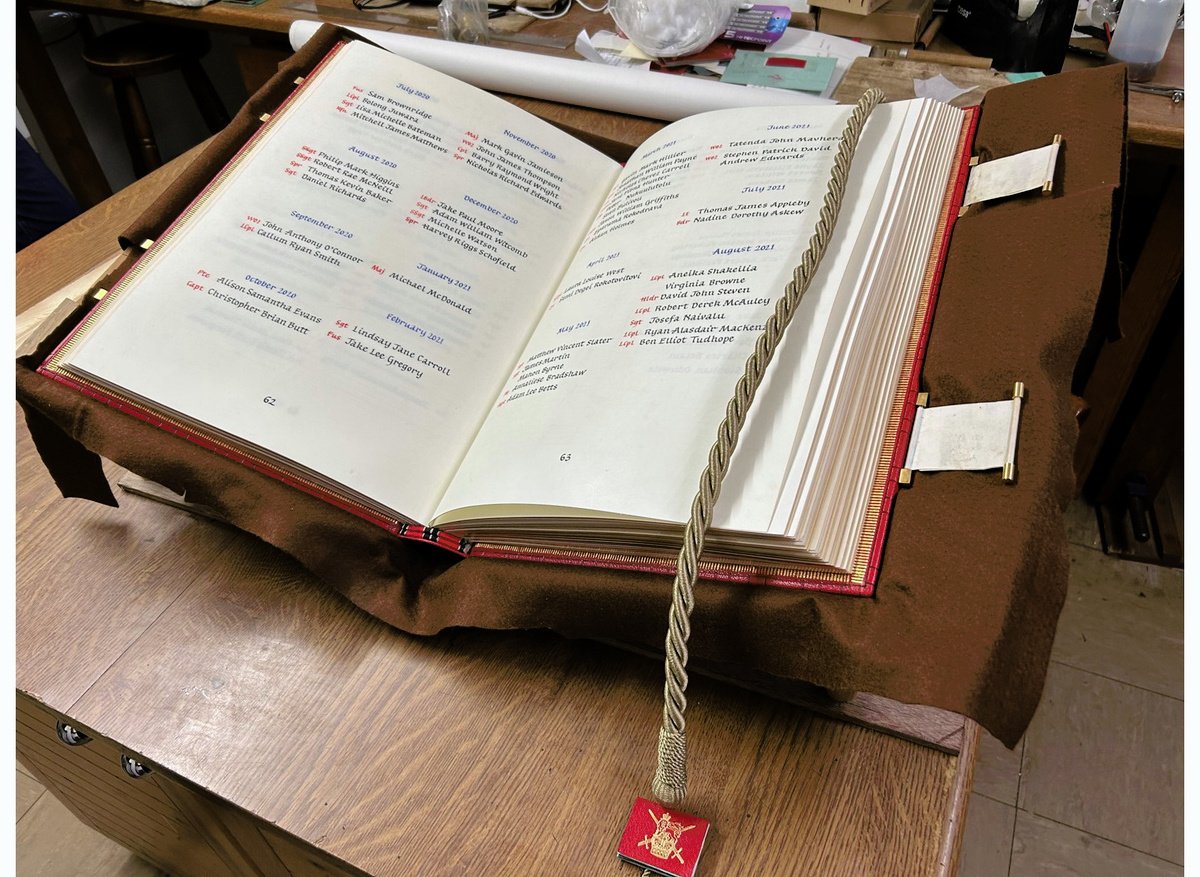
A book on its cradle being held by the page weights
The same gold blocking was added to the leather crossovers on the clasps – both sides, so as to be visible with clasps open or closed.
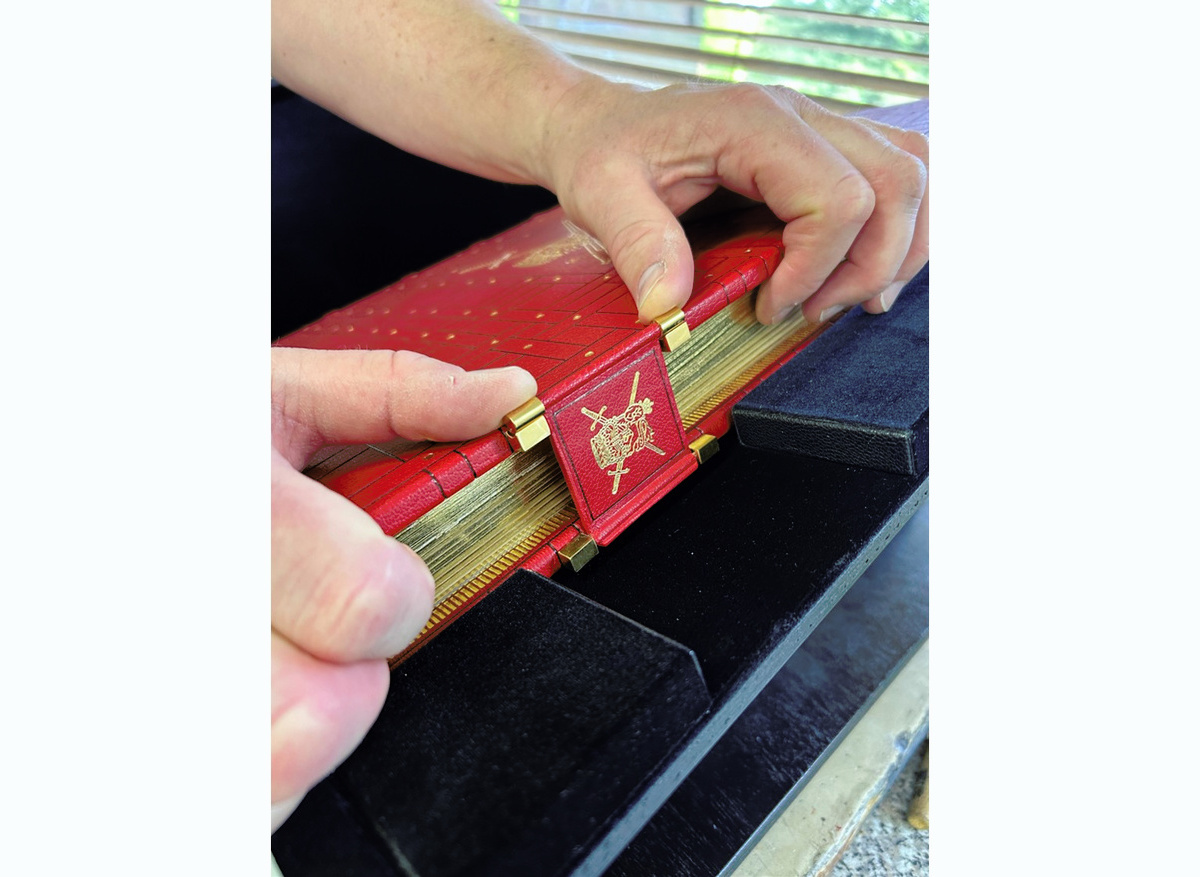
Clasps being opened
Display and Final Presentation
In addition, each of the four volumes had a full cloth box made, lined with velvet and with gold tooled recessed labels. And finally, we made a packing crate for a volume to be shipped to and from the calligrapher when required, with foam support blocks to aid the scribe.
The whole project took the bindery well in excess of 500 hours. The team consisted of Jackie Rice, Ted Bennett, Louise Brockman, Georgina Brockman, James Brockman and Stuart Brockman. It was a great honour for us all to work on books of such tremendous importance.
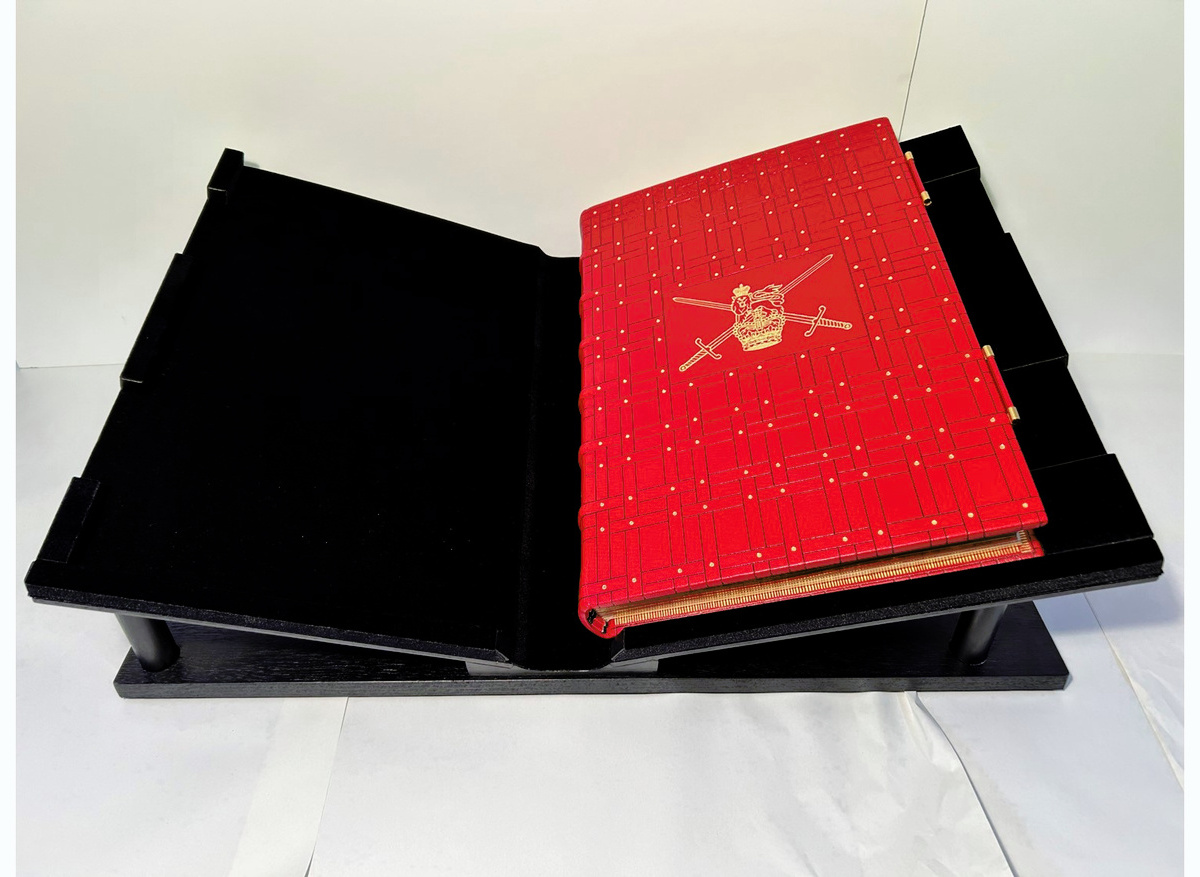
Closed book on cradle
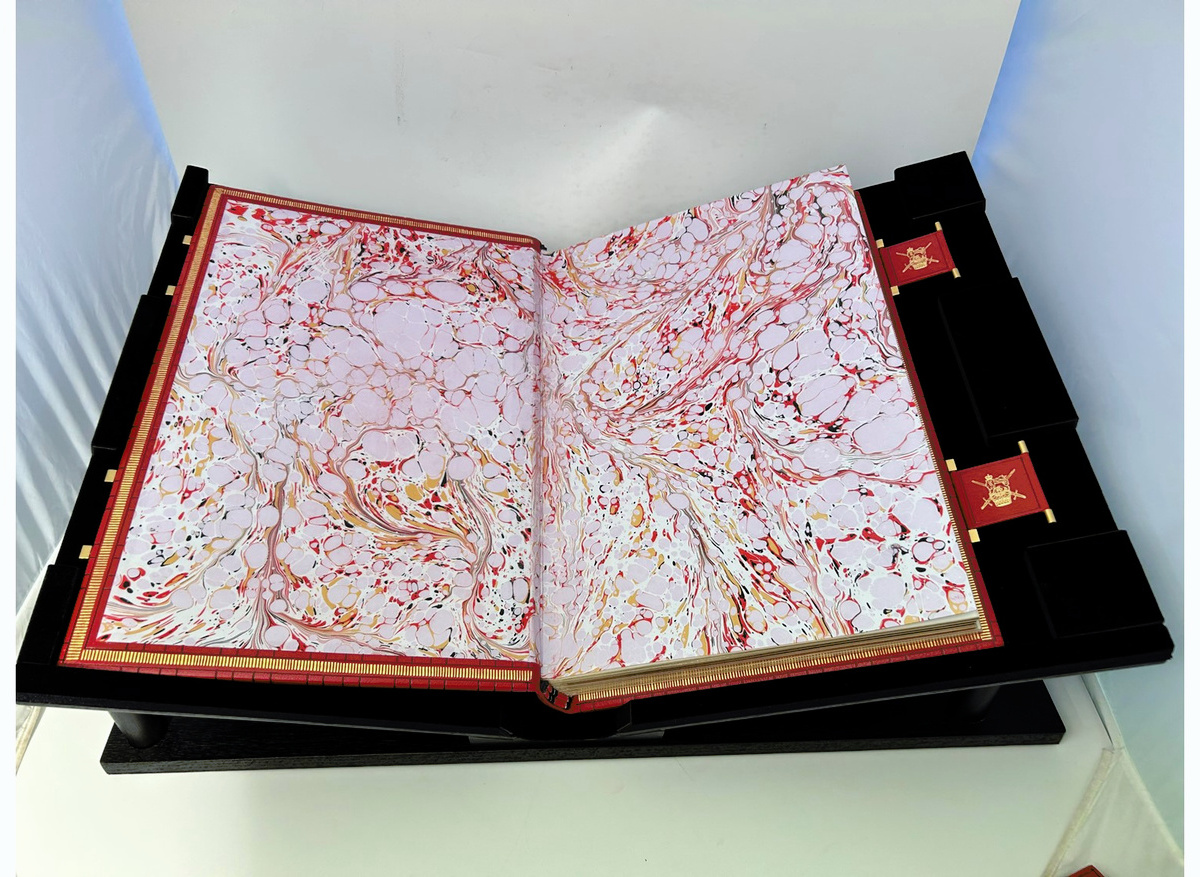
Open book on cradle
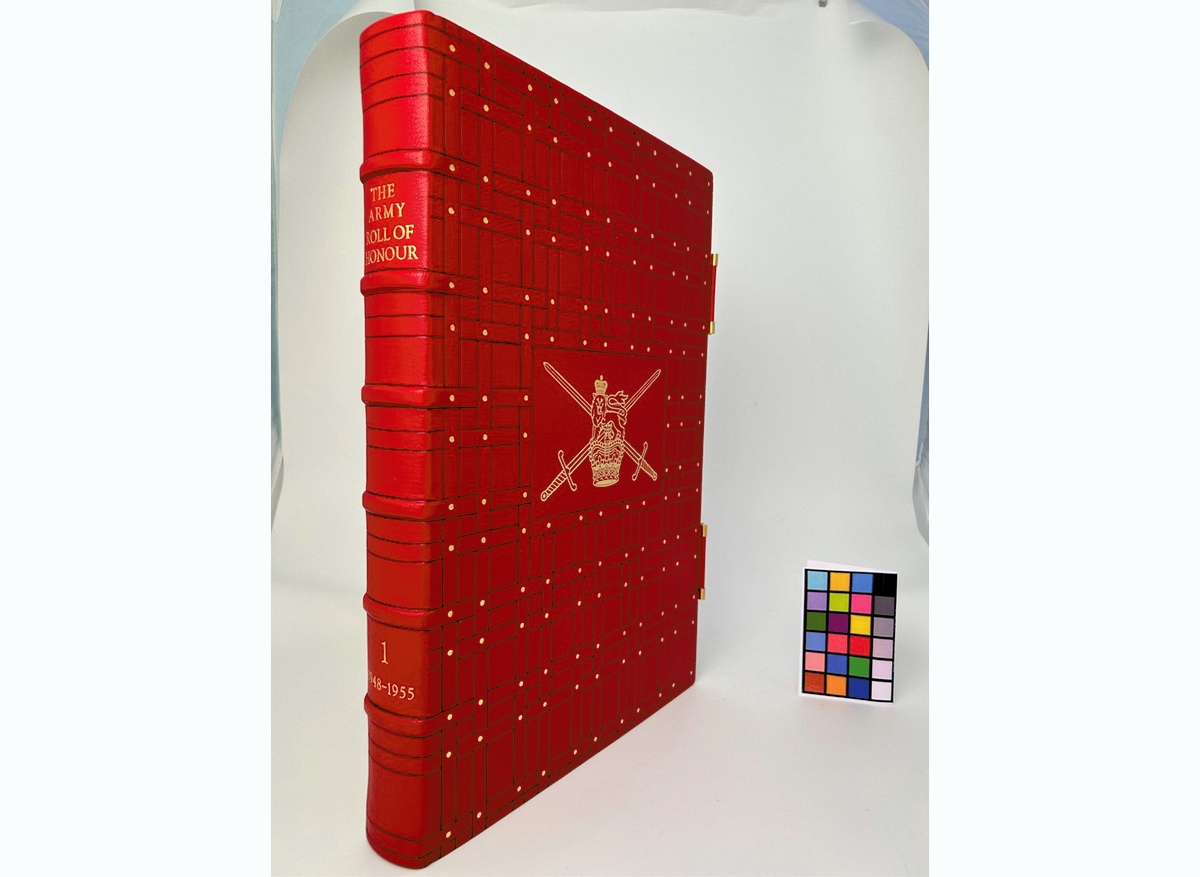
One of the volumes
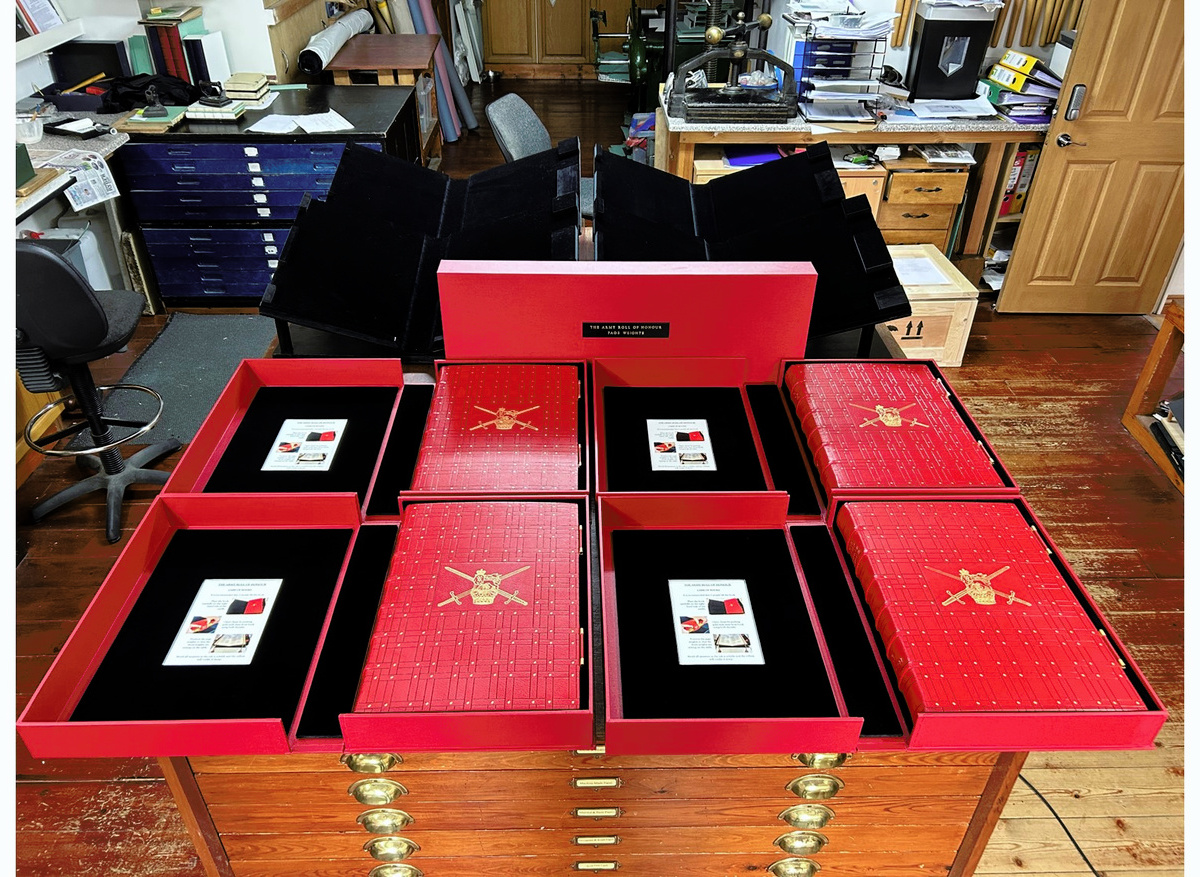
The whole project
By Stuart Brockman.
Click here to find out more about Brockman Bookbinders.