History of the Old Bailey
The Old Bailey (also known as the Central Criminal Court) is a place steeped in tradition and history. The oldest part of the building, the Sessions House, was designed by Edward William Mountford and was opened by His Majesty King Edward Vll on the 27th day of February 1907.
King Edward was told, at the time of opening of the Sessions House, that: “… whilst well adapted for the transaction of legal business, also possesses architectural features at once dignified and beautiful, which will make it an ornament to the metropolis of your Empire and a fitting home for the first Criminal Court of Justice in your Majesty's dominions.”
A 'Court-house for the trial of prisoners' has existed in the City of London from very early times, and the name of the Lord Mayor for the time being (now the Lady Mayor) has always been included in the Commission of Oyer and Terminer (i.e. to hear and determine serious criminal cases) by virtue of a charter of King Edward III of 6th March 1327.
In 1785 a new Sessions House was built by the Corporation of London, and was subsequently several times enlarged; it, however, proved quite inadequate to meet the demands of the beginning of the 20th Century and on 20th December 1902, the first stone of the present building (which stands upon the site of the ancient Prison of Newgate) was laid. The present building was erected at the sole cost of the Corporation of London to provide four Courts for the trial of accused persons; and arrangements were made for the reception of the Lord Mayor, His Majesty's Judges, the Aldermen, Sheriffs, and others connected with the administration of Criminal Justice.
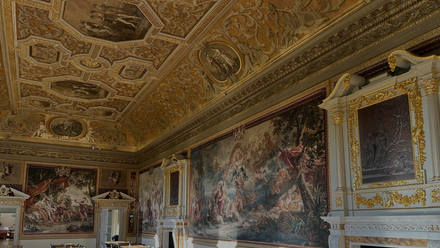
The magnificent Grand Hall has beautiful murals painted by Gerald Moira. Above the Grand Hall is the Dome with Pomeroy's Figure of Justice on top who sees all because she is not blindfolded. Court Number One is adjacent to the Grand Hall. Court Number One is grand and imposing with ornate woodwork under a high ceiling.
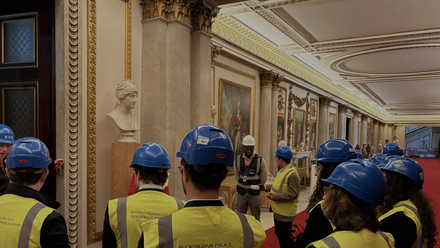
Below is the Lower Hall. The Lower Hall has marble columns, semi domes inlaid with mosaics and alcoves. The alcoves contain artefacts which hark back to the public executions of former times. There is also the plaque which recalls Penn and Mead and their writ of Habeas Corpus. A magnificent stained glass window has the coats of arms of Recorders of London.
We shall be meeting inside the main entrance at 5.15pm for the tour to start at 5.30pm which is on Old Bailey Road. Mr Jay Patel will be conducting the tour.
The tour will last approximately 90 minutes and may run longer depending on questions.
The address of the Old Bailey is:
Central Criminal Court, Old Bailey, City of London, London EC4M 7EH
The nearest underground station is St. Paul's on the Central Line.
Please note:
-
Upon arrival, everyone will need to go through airport-style security and bring a valid form of photo ID.
-
Comprehensive security measures include 24/7 CCTV surveillance, X-ray screening, body searches, and regular patrols. Please cooperate during checks and report any suspicious activity to security staff.
-
There is no admission for children under 14 and proof of age may be requested by security.
-
Sharp objects, perfumes, and sprays are not permitted in the building.
-
There will be a fair amount of walking, so it’s best to travel light.
If there are any accessibility requirements, please let Michel Aslangul know by Friday 16 January 2026 at
[email protected]
AGM Agenda
- Welcome and Introduction by the Chair, Anthony Beech ACR
- Apologies for Absence
- Minutes of the previous AGM
- Annual report
- Annual accounts
- Elections to the committee
- Looking ahead
- AOB