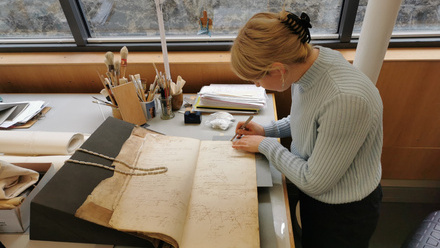
For the past year, I’ve had the privilege of being an Icon intern in manuscript conservation at Senate House Library, University of London. While I have worked on several fascinating projects, the highlight has undoubtedly been MS278, Robert of Gloucester’s Chronicle. Rebinding this 15th-century manuscript has given me the opportunity to learn new skills – and make a fascinating potential discovery.
MS278 – Robert of Gloucester’s Chronicle
Robert of Gloucester’s Chronicle is a history of England from mythological origins up until (in this version) the 1280s, written in Middle English in verse. In MS278, the text is written in black ink and the rhyming couplets marked with a red bracket. The first letter of each line is washed with yellow. The manuscript is also full of wonderful “grotesques”, doodles of little figures. At the end of each quire (a gathering of folded sheets) these grotesques often incorporate the catch word – the first few lines of the next quire.
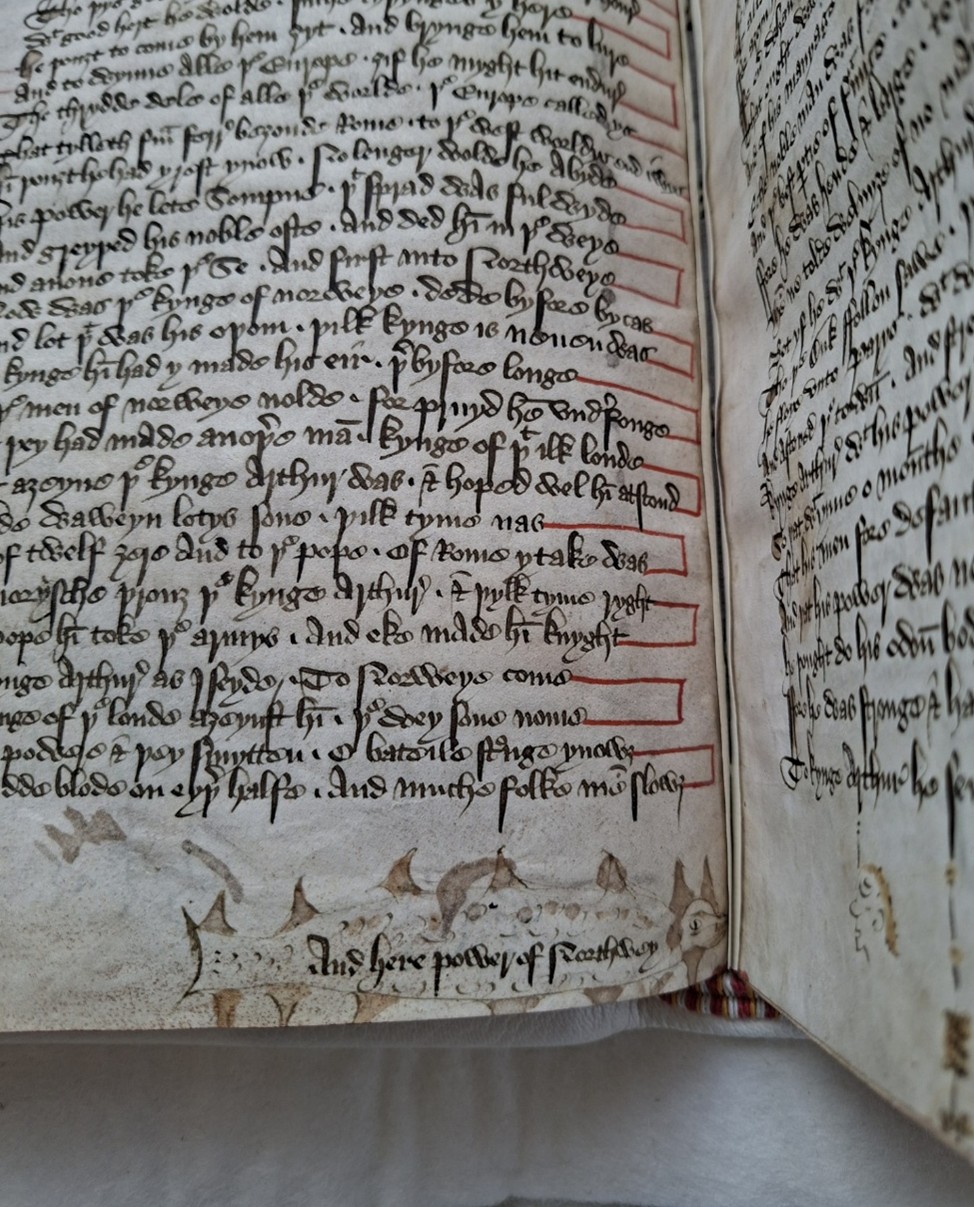
My favourite catch word – in a fish!
When I began my internship, MS278 was in an early 19th-century binding, sewn on single cords, rounded, backed and covered in parchment with gold tooling. There are two bookplates in this binding: the bookplate of Sir Roger Mostyn (d. 1739) and the bookplate of Gloddaeth Hall, the seat of the Mostyn family. The Mostyns owned MS278 from 1685 to 1920, when much of Gloddaeth Library was sold. Two years before that, in 1918, most of the Welsh material in Gloddaeth Library was gifted to the National Library of Wales. Comparing MS278 to the Mostyn Collection at the National Library of Wales, it was clear that the parchment binding was part of Gloddaeth Library’s house style, and is significant to the manuscript’s provenance.
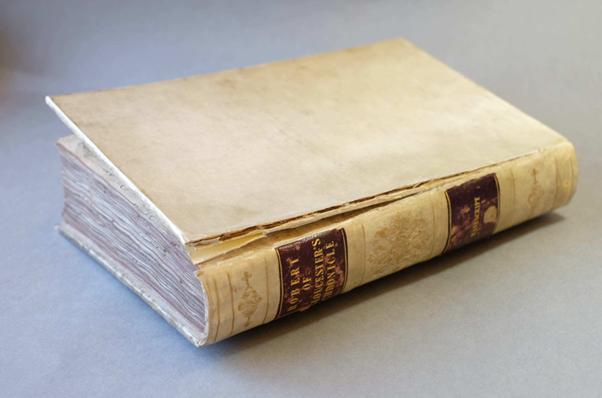
The early-19th-century binding
However, over time and use, the structure – not designed for the strain of parchment which fluctuates in changing humidity levels – had begun to fail. The sewing had broken in three places and the left board was almost entirely detached. The inherent structural weakness meant localised repairs would have failed again in a few years. Therefore, in consultation with my supervisor Salvador Alcántara Peláez and the manuscript curator Tansy Barton, I decided to disbind MS278 and rebind it in a manuscript conservation binding, held between thick wooden boards to prevent cockling. Everything from the historic binding was kept and will be housed together with the manuscript.
Rebinding the Chronicle
After removing the old boards and pulling the existing sewing thread to separate the quires, I first repaired the damage to the spine folds. I used alum-tawed caecum (a thin, flexible material made from animal intestine) and gelatine to repair tears and infill losses. I then had my first consultation with Edward Cheese ACR, an experienced manuscript conservator, who advised me to humidify and flatten each spine fold to remove the rounding and backing and help the quires sit tightly together.
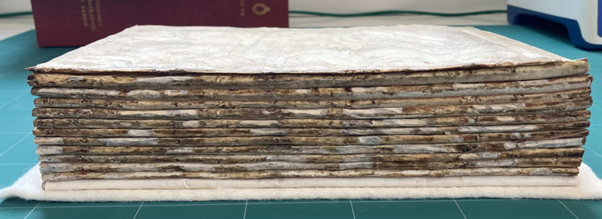
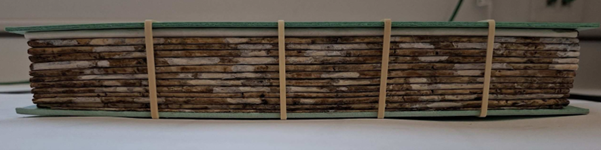
Held tightly between pieces of millboard by elastic bands, the manuscript then sat for 2 months to take on a memory of the new shape. After that, I resewed it on new double sewing supports of thick cords, reusing the 19th-century sewing holes. Edward also showed me how to make alum-tawed endleaves, which create strong and flexible internal joints.
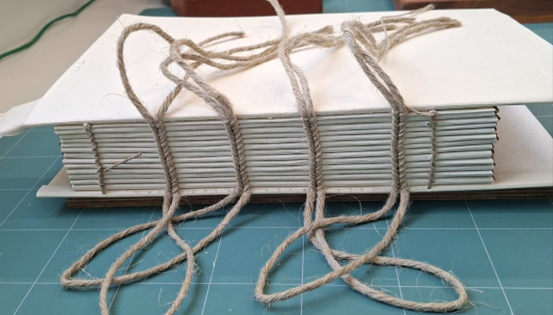
The resewn manuscript
The next step was to shape the new wooden boards, and this was another chance to learn new skills. The entire conservation studio went to visit master cabinet maker Bernard Allen for 2 days at his studio in North Wales and came back with our heads buzzing from all we learnt!
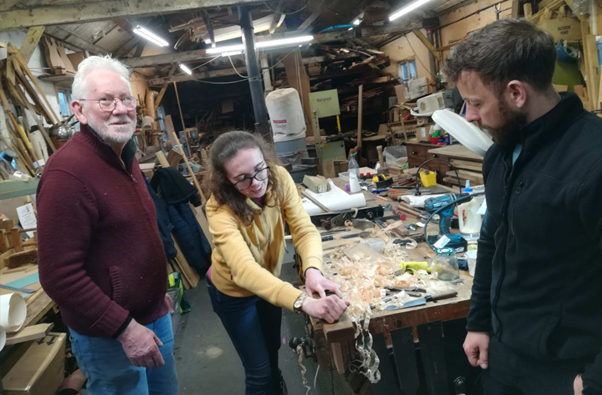
Bernard, me and conservator Christos Fotelis at work in Bernard’s studio
After shaping the boards following Bernard’s instructions, I made a loose aerolinen spine liner to cover the spine and protect it from adhesive, then laced the manuscript into the boards. I always think this is the most exciting moment of rebinding a book – suddenly, it stops looking like a pile of folded sheets of paper and starts looking like a book!
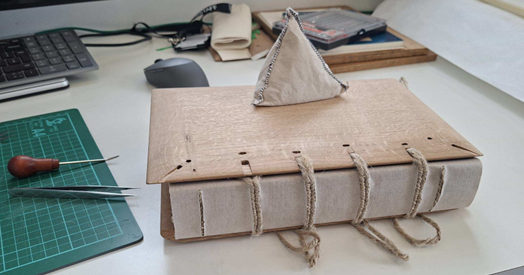
The next step was to work primary endbands over the liner to hold it in place and control the opening of the book. Edward came to consult again and following his advice, I created secondary endbands with two further cores. This raised the endbands to the height of the boards and reduced the opening arch.
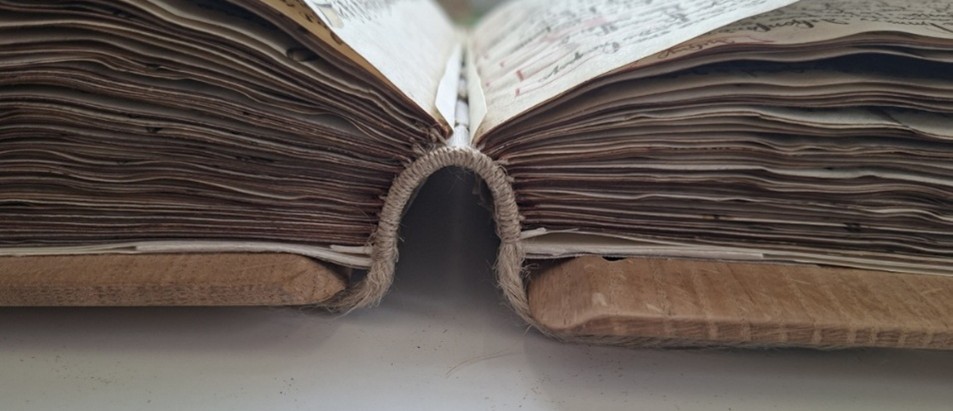
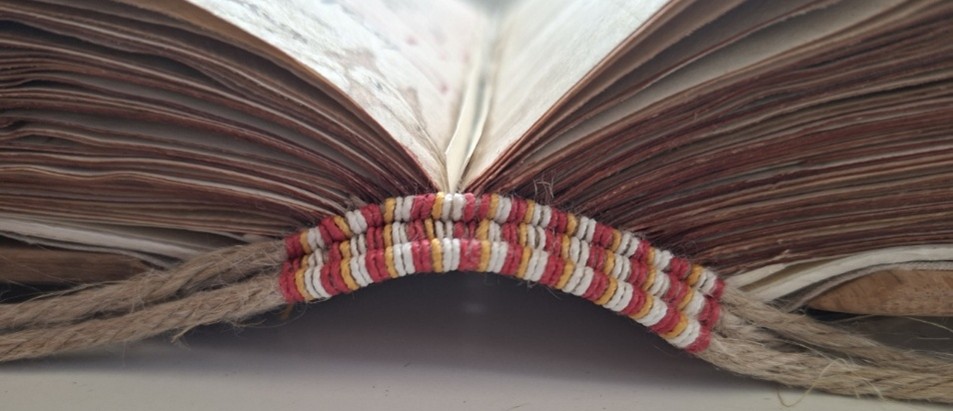
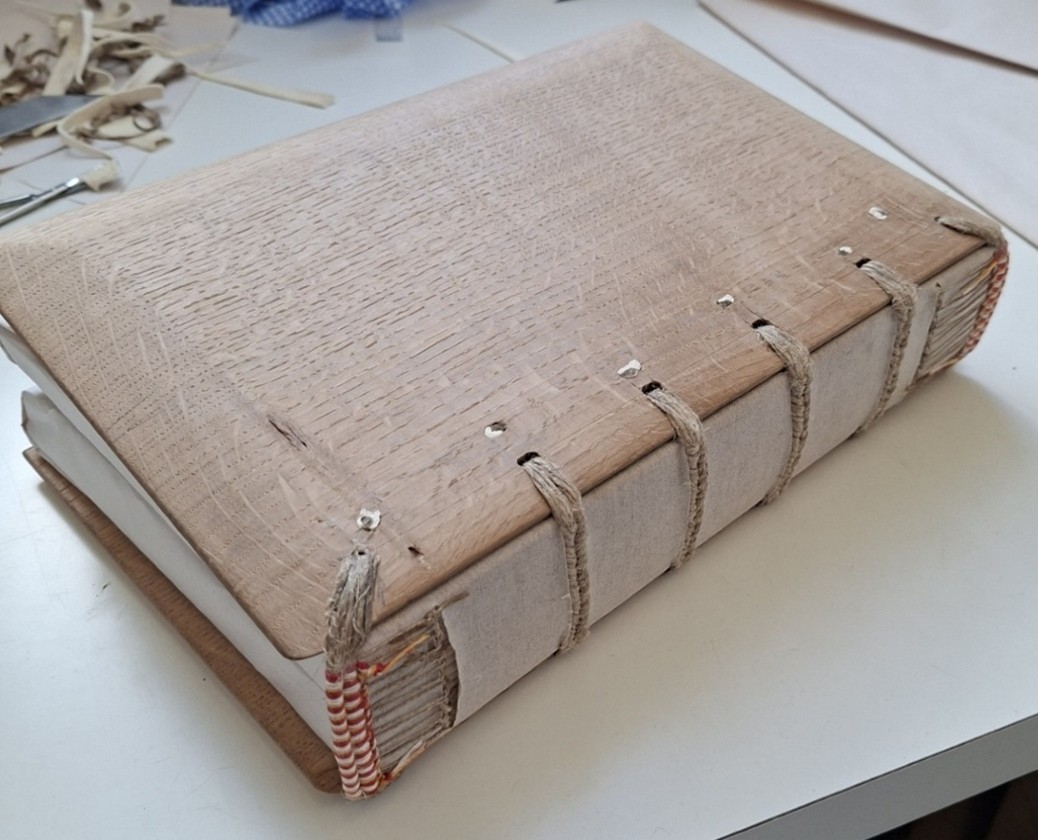
Finally, I covered the book with alum-tawed skin and sewed the endbands to the head and tail of the spine covering. This helps secure everything at the spine, rather than relying on adhesive. With a few finishing touches, the rebinding was finished! It can now be safely used again for teaching or by readers in the special collections reading room.
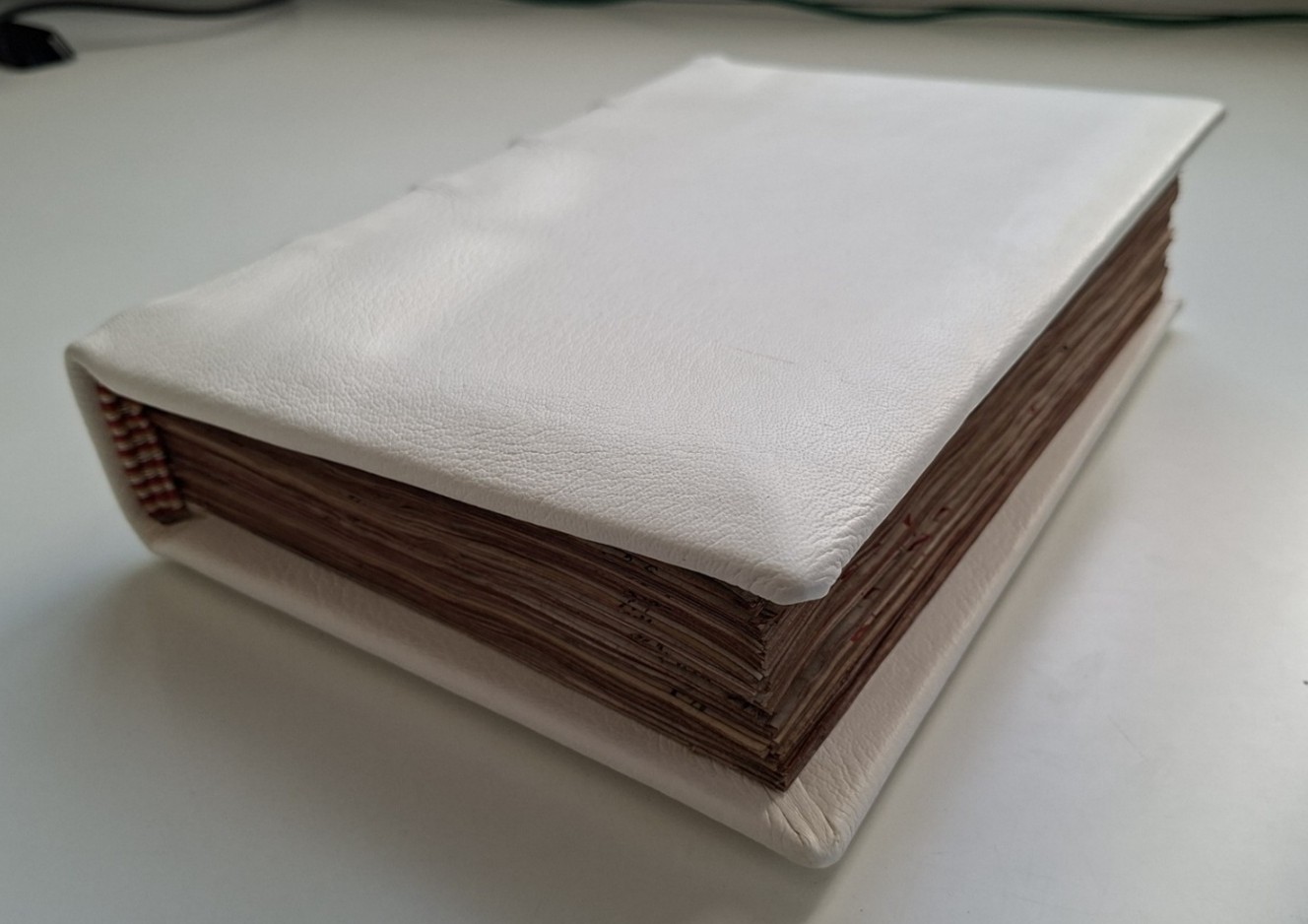
The Chronicle and the Guildhall
One of the privileges of conservation is how well you can come to know the objects you work on. In this case, thanks to an unbelievable coincidence, this led to a tantalising potential discovery.
As mentioned, MS278 was owned by the Mostyn family from 1685 to 1920, when it was sold and eventually made its way to the University of London. In 1685, Sir Thomas Mostyn bought it from the estate of Robert Bruce, 2nd Earl of Elgin. He had inherited it from Lady Diana Cecil, who in turn had inherited it from William Cecil, 1st Baron Burghley and advisor to Elizabeth I (d. 1598). Where did Cecil get it from? This is where unbelievable coincidences come in.
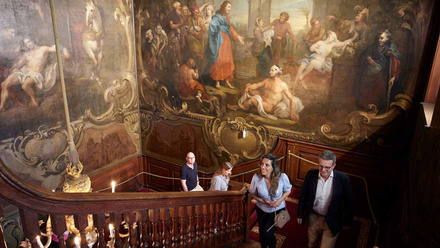
As part of a group of Senate House Library staff, I visited the Guildhall Library’s 600th anniversary exhibition. The library has a fascinating history – first founded by an endowment in Dick Whittington’s will, it was forced to close in 1549 or 1550 when all the books were “borrowed”, and a new library only opened in 1828. While there, I learned that according to new research, the medieval library’s books were not “borrowed” by Edward Seymour, Duke of Somerset, as previously thought, but by William Cecil. Yes, as Salvador pointed out to me, that William Cecil.
Of course, Cecil was a great collector of books and we don’t know how he obtained MS278. There is also no booklist from the medieval Guildhall Library and only one surviving book has been identified from the original library, thanks to an inscription on the flyleaf. There was no particular reason to think MS278 was one of the “borrowed” books. But I was curious and decided to have another look to see if I could find anything. And I found this on the left endleaf:
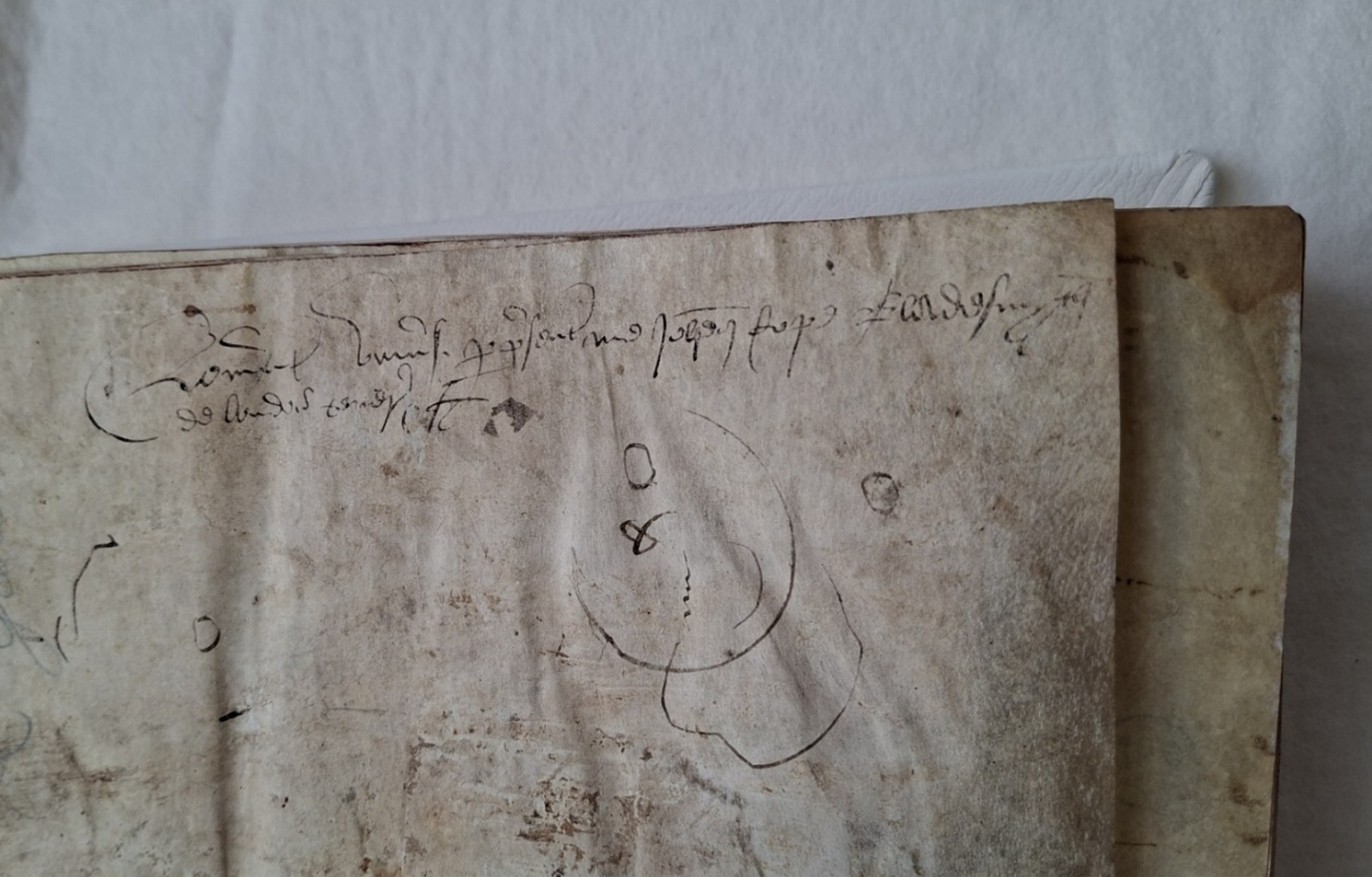
Left endleaf with a note written down the right edge
For those, like me, who don’t read 15/16th-century script, the writing down the right of the leaf says:
Nov’int Univ’si p p’sent me Iohnes Cope Bladesmyth
De london’ tener’ etc
This is the standard opening of a deed: “Know all men by these presents that I, John Cope, bladesmith of London, am held…”. John Cope was master of the Mistery (i.e. guild) of bladesmiths. And the deeds of the Mistery of Bladesmiths were held at the Guildhall.
Excitedly, I told the librarian at the Guildhall, Melanie Strong, about this, which ultimately led to Melanie visiting Senate House Library with Dr Ryan Perry, who led a project looking at the original Guildhall Library. On their visit, Ryan identified 3 strange marks on the first leaf as possible evidence of chain pins. There are larger, but similar, marks on the only identified Guildhall book.
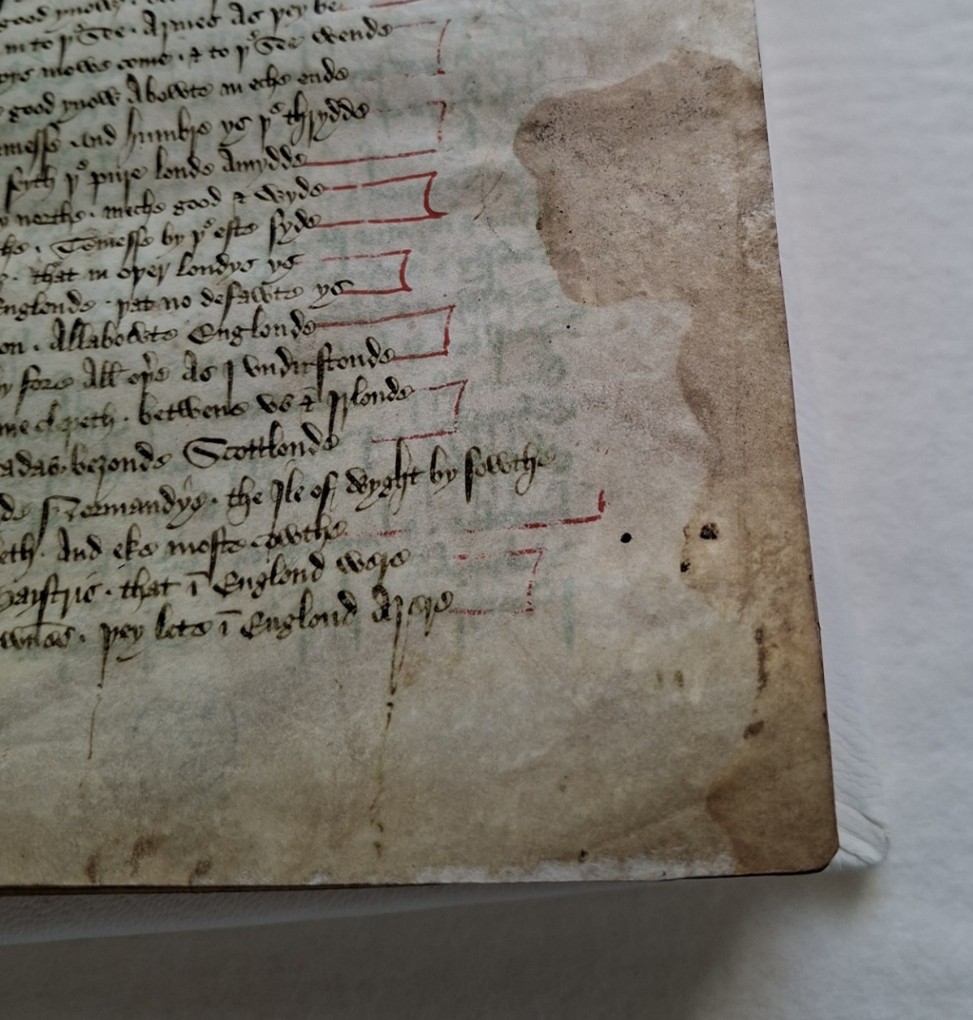
None of this is conclusive evidence. Further research is needed before we can say that Senate House Library MS278 was once part of the medieval Guildhall Library. But it is possible, and I am so glad that I was able to look into it as part of my internship.
Working with Robert of Gloucester’s Chronicle has been an absolute honour, and it wouldn’t have been possible without a huge range of people: Salvador, Christos, Tansy, Edward, Bernard, Melanie and Ryan, thank you! And of course, huge thanks to everyone at Senate House Library and Icon; The Anna Plowden Trust, Idlewild Trust, The Julia Rausing Trust, The Pilgrim Trust, The Radcliffe Trust and National Manuscripts Conservation Trust, whose made this internship possible; and the University of London Convocation Trust, who enabled me to attend so many CPD events. Thanks to all of you, I have had the most wonderful start to my career.