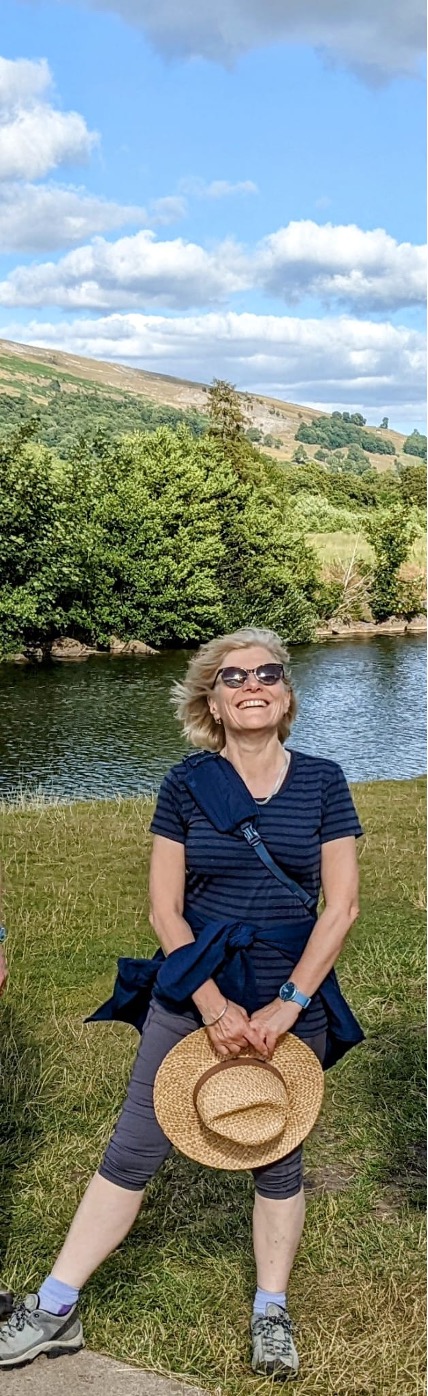
For the second edition of our Private Practice Series, we'd like to introduce Bridget Warrington who is a freelance Libraries & Archive Conservator.
Name: Bridget Warrington
Specialism: Libraries and Archive
Employment status: Freelance/Independant
Business Name: Cambridge Conservator
Location: Yorkshire Dales (relocated studio in 2021)
Premises: Yes
What inspired you to work in cultural heritage and conservation?
It was a mid-life career change for me. After graduating in History from University of Reading, I had an initial career in publishing. I worked for book publishers as an editor and then moved across to newspapers, worldwide newsletters, streamed news services and finally online services. At that stage, I decided that I missed books, so I re-trained as a bookbinder and then as a library and archives conservator.
How long have you been in private practice?
I set up my own business in April 2018, so 8 years now.
What have you enjoyed most about being in private practice, what keeps you in it?
I love being an independent conservator and having my own studio to develop my skills.
There are certainly tough aspects to working on your own, but they are outweighed by the sense of freedom from being your own boss.
What’s your favourite non-conservation skill in your toolkit?
That’s a tricky question as I think so many skills have their uses within conservation. My favourite non-conservation skill would be loom weaving.
What do you think emerging conservators need to know before starting in private practice?
They need to understand how to run their own business, both practically and in terms of developing good client liaison skills. Also essential is to be well practised in estimating so that they are not consistently under-charging and to understand cash-flow, as so many sole traders find this the most difficult aspect of running your own business.
What do you think is key to making private practice more accessible and attractive as a career choice in conservation?
Introducing private practice to conservation students and giving them a grounding in conservation business skills would be a good start. Perhaps introducing a mentoring scheme to support anyone who is setting up, so that they can call on advice from an experienced independent conservator.
Where has been the most unusual place you’ve undertaken conservation?
When I worked for the Churchill Archives Centre, Senior Conservator Sarah Lewery organised a staff disaster training event in association with Cambridge Fire Brigade. The Archives building was evacuated by the staff and then the fire brigade carried out a retrieval exercise of a bogus collection of boxes, wearing full fire kit, helmets and breathing apparatus. The store room was in complete darkness, so the fire brigade could only use torches to negotiate their way around an unknown space and find the collection that needed to be removed. They had to set up a human chain to the back door of the building where it was passed to staff who then underwent their own training session for setting up a temporary salvage area. One member of staff was required to stay in the storeroom during the whole fire brigade exercise, and that was me. So, when the alarms went off and the lights dimmed, I made my way to the storeroom and hid behind one of the plan chests to await the fire brigade. It was quite frightening as well as exhilarating when 20 minutes later the fire brigade made their entrance and began searching for the required collection of boxes. Conservation in action!
What do you listen to whilst working?
The radio – usually Radio 2, sometimes Radio 3 – and podcasts.
Tell us about a favourite project of yours
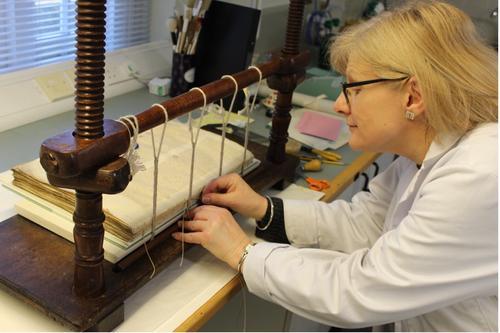
To be honest, my favourite practical project is usually the one I’m working on at the time. At the moment I’m conserving a sixteenth-century binding that has insect damage to the front board as well as multiple board splits. As well as running my own studio, since 2022 I have been studying part-time for a PhD with the University of Lincoln. My thesis focuses on the evolution of twentieth-century book repairs after World War II, drawing data from library surveys as well as oral-history interviews. After four years of research and data-gathering, as of this year I’m in the analysis and writing-up phase and am thoroughly enjoying it.
What’s the best piece of advice you’ve been given or would give to others?
If you enjoy what you do, you’ll do it well.